Loading…
Science
Ice bath after workout: when it helps and when to skip it
11 min read
An ice bath after a workout is one of those habits that's right for some sessions and wrong for others. If you've just done a hard run, a long ride, intervals or ninety minutes of football, it may help you feel less sore tomorrow. If you've just lifted weights because you want to get stronger or bigger, the best evidence says an ice bath straight afterwards works against you.
That second part surprises people, so this page spends time on it. We sell ice baths, including the Plunge 320 at £109, and we'd rather you used one on the right days than every day. All the studies below were read again from their published abstracts on 30 September 2026.
Should you take an ice bath after a workout?
It depends on the workout and on what you're training for.
- Hard endurance, intervals or team sport, and you need to go again within a day or two: yes, it may help.
- Strength or muscle-building sessions: not straight after. Keep the two apart.
- An ordinary gym session you're not sore from: it won't hurt, and there's little evidence it adds anything to your training.
Here's the evidence behind each line.
The recovery evidence: what an ice bath after exercise can do
Cold water after exercise has been tested a lot, mostly against sitting and resting.
Bleakley and colleagues' 2012 Cochrane review pooled 17 small trials with 366 participants. Cold water immersion reduced muscle soreness compared with rest at 24, 48, 72 and 96 hours. Two of the trials also found people rated their fatigue lower straight afterwards. The reviewers called the study quality low and the conclusion is suitably modest: some evidence that it reduces delayed onset muscle soreness.
Machado and colleagues (2016) pooled nine randomised trials and came to a similar place. Cold water immersion can be slightly better than passive recovery for muscle soreness, with the best results at 10 to 15°C for 10 to 15 minutes.
Moore and colleagues (2022) is the biggest analysis, with 52 studies in physically active people, and it split the results by type of exercise. That split is the useful part.
After high-intensity exercise, cold water immersion improved recovery of muscular power at 24 hours, reduced muscle soreness, improved how recovered people felt, and lowered a blood marker of muscle damage.
Eccentric exercise, the heavy muscle-lengthening work that causes the worst next-day soreness, was a different story: the only benefit there was to muscular power at 24 hours.
And in neither case did it make a significant difference to recovery of strength.
Team sport has its own review. Higgins and colleagues (2017) pooled 23 studies with 606 participants. Cold water immersion helped recovery of jump and sprint performance 24 hours after team sport, and helped perceived fatigue at 72 hours. It did not improve perceived muscle soreness in that setting.
Put those together and the claim we're comfortable with is this. After a hard, high-intensity or endurance session, an ice bath may help you feel less sore and get some power back by the next day. The effects are small to moderate, and they're measured against resting, not against anything clever.
The strength finding: Roberts 2015
Now the study everyone training with weights should know about.
Roberts and colleagues (2015), published in The Journal of Physiology, took 21 physically active men and had them strength train twice a week for 12 weeks. After every session, one group did 10 minutes of cold water immersion. The other did active recovery.
At the end, strength and muscle mass had increased more in the active recovery group. Isokinetic work had gone up 19%, the cross-sectional area of type II muscle fibres 17%, and the number of myonuclei per fibre 26% in the active recovery group. None of those increased in the cold water group.
A second experiment in the same paper looked at why. Nine men did single-leg strength exercise followed by cold water or active recovery, and had muscle biopsies taken over the next two days. The signals that tell muscle to grow, including satellite cell activity and a key growth-regulating enzyme, were lower after cold water.
The authors' conclusion was that using cold water immersion as a regular post-exercise recovery strategy should be reconsidered.
It wasn't a one-off
Three later pieces of work point the same way.
Fyfe and colleagues (2019) ran a seven-week programme with 16 men lifting three days a week, followed by either 15 minutes in 10°C water or 15 minutes sitting at room temperature. Growth in type II muscle fibre size was blunted in the cold water group. Interestingly, the gain in one-rep-max leg press was similar in both groups. Their conclusion: post-exercise cold water immersion should be avoided if muscle hypertrophy is the goal.
Fuchs and colleagues (2020) had 12 men put one leg in 8°C water and the other in 30°C water for 20 minutes after resistance exercise. The cold leg built new muscle protein more slowly, both over the following five hours and across two weeks of training.
Malta and colleagues (2021) pooled eight studies in a meta-analysis. Regular cold water immersion alongside resistance training had a harmful effect on strength gains. Alongside endurance training, it had no effect either way.
What this does and doesn't mean
It doesn't mean one ice bath ruins a training block. These studies used cold water after every strength session for weeks.
Nor does it mean cold water makes you weaker. People in the cold water groups still improved. They improved less.
What it does mean is that if your reason for being in the gym is to build muscle or strength, a routine ice bath straight after lifting is a poor trade. You'd be swapping a little less soreness for a little less of the thing you're training for.
There's one more finding worth having. Part of the traditional case for the post-gym ice bath is that it reduces inflammation in the muscle. Peake and colleagues (2017) tested that directly, comparing 10 minutes in 10°C water with 10 minutes of easy cycling after resistance exercise. Inflammation and cell stress in the muscle were no different between the two. An easy spin on the bike did the same job.
Ice bath after the gym: what to do by type of session
Weights for size or strength. Don't plunge straight after. Put your ice bath on rest days or cardio days. If you train with weights most days and still want to plunge, do it as far from your lifting as your day allows, such as first thing in the morning when you lift in the evening. We haven't found a trial that tested how long a gap is long enough, so we won't give you a number of hours as if it were established.
Running, cycling, rowing, swimming. This is where the evidence is friendliest. Malta's meta-analysis found no harm to endurance gains, and Broatch and colleagues' 2018 review describes cold water as having little to no effect on the long-term markers of endurance adaptation. If you've done a hard session and you're training again tomorrow, an ice bath afterwards is reasonable.
Intervals, circuits and classes. These are the high-intensity sessions in Moore's analysis, where soreness, perceived recovery and power all came out better with cold water. If the class is mostly heavy lifting, treat it as a strength session.
Football, rugby, hockey, netball. Higgins' review supports cold water for getting sprint and jump performance back within 24 hours. That matters in a tournament weekend or a week with two fixtures. In pre-season, when the point of training is to adapt, there's a case for using it less.
Mixed sessions. Plenty of people lift and then run, or the other way round. Decide by your priority. If you care most about the lifting, skip the plunge. If the lifting is light maintenance and the run was the real work, go ahead.
Competition versus training. On the day of an event, or between rounds, adaptation isn't the goal. Feeling ready is. That's when a post-exercise ice bath makes the most sense for anyone, lifters included.
How to do a post workout ice bath
The protocol that matches the research is simple.
- Cool down and have a drink first. Walk for a few minutes and let your breathing and heart rate come down before you get into cold water.
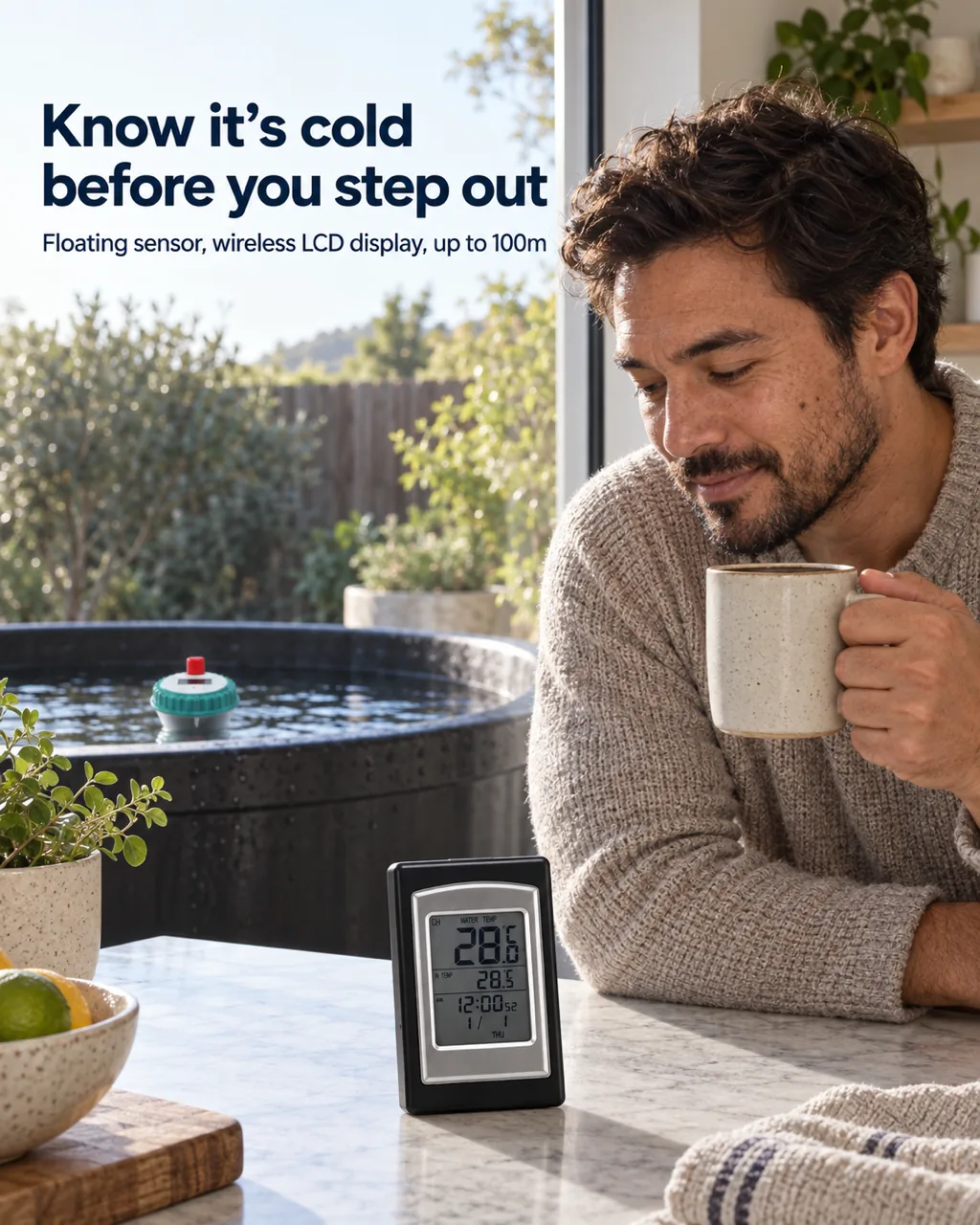
- Check the water. Aim for 10 to 15°C. Our Wireless Floating Thermometer, £29, floats in the tub and shows the reading on an indoor display. In summer you'll need ice to get there. In winter the tap may do it.
- Get in slowly. Sit down gradually and breathe out. The first minute is the hard part.
- Stay 10 to 15 minutes if you're used to it. Less if you're new. Machado's analysis found that range did best, and nothing suggests longer is better.
- Get out, dry off, dress warmly. Move around. A warm drink is pleasant.
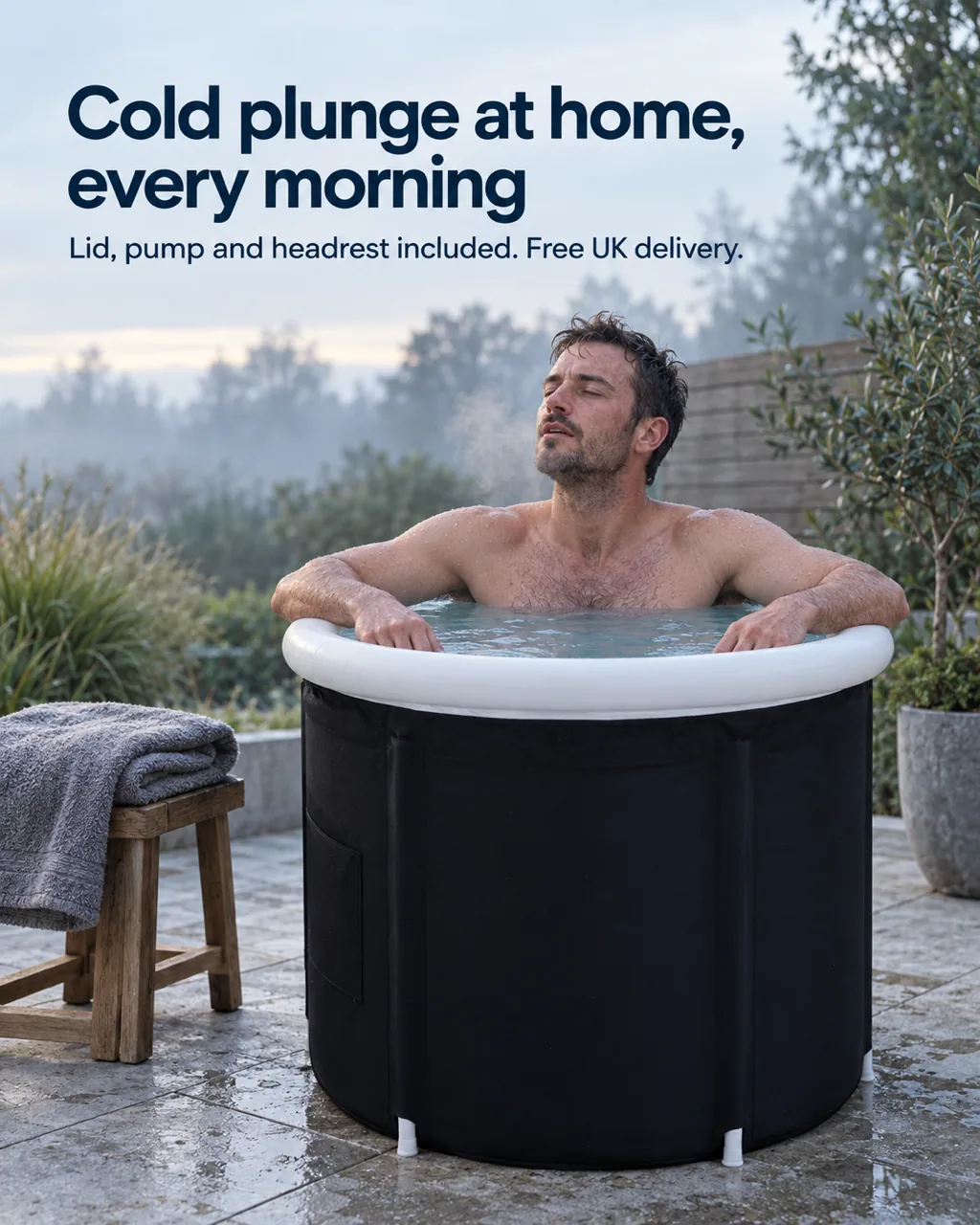
Peake's study immersed the lower body, and a sit-in tub covers that and more. The Plunge 320 is 83cm across and 73cm tall and holds more than 380 litres according to the supplier, so there's depth to sit in. It comes with a lid, which keeps debris out between sessions.
Our temperature guide and how long to stay in page go further on both numbers.
Is an ice bath better than other recovery?
Most of the supporting studies compare cold water with passive rest. Against doing nothing, it comes out ahead for soreness. Against light activity, the Peake study found no difference in what was happening inside the muscle, and in Roberts' study the comparison group doing active recovery ended up stronger.
So an easy ten minutes on the bike or a walk is a perfectly good cool-down, and if you lift, it's the better one. Sleep and eating properly come first. An ice bath is an extra. If you enjoy it and it makes hard training weeks feel more manageable, that's worth something. It isn't essential and nobody's progress depends on it.
If you like having a few recovery tools to hand, we also sell a Travel Foam Roller at £39. We make no claims for it beyond it being a pleasant way to roll out your legs after training.
Safety straight after exercise
You're warm, your heart rate is up and you may be a bit dehydrated. Cold water on top of that is a jolt. The British Heart Foundation notes that entering very cold water can cause a cold shock, with a faster heart rate, higher blood pressure and shortness of breath.
So don't jump from the last rep into the tub. Give yourself a few minutes. Don't plunge alone, particularly after a session that's left you light-headed. Get out if you feel dizzy, confused or unwell, or have any chest discomfort. And if you have a heart condition or high blood pressure, speak to your doctor before using cold water after exercise at all.
Who this is not for
If your training is mostly lifting and your goal is size or strength, a routine ice bath after the gym isn't for you. Plunge on other days, for other reasons.
An ice bath isn't treatment for an injury either. See a physiotherapist.
People who are new to exercise and a bit sore after their first sessions don't need one. That early soreness usually eases as your body gets used to the work.
And if you have a heart condition, or you've been told to avoid cold exposure, take medical advice first.
The short version
After hard cardio, intervals or sport, when you need to feel good again soon: an ice bath at 10 to 15°C for 10 to 15 minutes may help with soreness and next-day power.
For strength training aimed at size or strength: skip it. Roberts and colleagues found smaller gains with a cold plunge after every session, and later studies back that up.
If you want to set one up at home for the right days, the Plunge 320 at £109 is the tub we'd use, with a thermometer so you know the water's in range. Our muscle recovery article goes deeper into the research if you want the detail.
This article is for general information and does not constitute medical advice. Cold water immersion carries cardiovascular and hypothermia risk, particularly for people with heart conditions, uncontrolled high blood pressure, or a history of arrhythmia. Consult a doctor before starting, never plunge alone, and stop immediately if you feel unwell.
References
- 1.Roberts LA, Raastad T, Markworth JF, et al. (2015). Post-exercise cold water immersion attenuates acute anabolic signalling and long-term adaptations in muscle to strength training. The Journal of Physiology, 593(18), 4285-4301.
- 2.Fyfe JJ, Broatch JR, Trewin AJ, et al. (2019). Cold water immersion attenuates anabolic signaling and skeletal muscle fiber hypertrophy, but not strength gain, following whole-body resistance training. Journal of Applied Physiology, 127(5), 1403-1418.
- 3.Malta ES, Dutra YM, Broatch JR, Bishop DJ, Zagatto AM. (2021). The Effects of Regular Cold-Water Immersion Use on Training-Induced Changes in Strength and Endurance Performance: A Systematic Review with Meta-Analysis. Sports Medicine, 51(1), 161-174.
- 4.Fuchs CJ, Kouw IWK, Churchward-Venne TA, et al. (2020). Postexercise cooling impairs muscle protein synthesis rates in recreational athletes. The Journal of Physiology, 598(4), 755-772.
- 5.Peake JM, Roberts LA, Figueiredo VC, et al. (2017). The effects of cold water immersion and active recovery on inflammation and cell stress responses in human skeletal muscle after resistance exercise. The Journal of Physiology, 595(3), 695-711.
- 6.Moore E, Fuller JT, Buckley JD, et al. (2022). Impact of Cold-Water Immersion Compared with Passive Recovery Following a Single Bout of Strenuous Exercise on Athletic Performance in Physically Active Participants. Sports Medicine, 52(7), 1667-1688.
- 7.Bleakley C, McDonough S, Gardner E, Baxter GD, Hopkins JT, Davison GW. (2012). Cold-water immersion (cryotherapy) for preventing and treating muscle soreness after exercise. Cochrane Database of Systematic Reviews.
- 8.Machado AF, Ferreira PH, Micheletti JK, et al. (2016). Can Water Temperature and Immersion Time Influence the Effect of Cold Water Immersion on Muscle Soreness? A Systematic Review and Meta-Analysis. Sports Medicine, 46(4), 503-514.
- 9.Higgins TR, Greene DA, Baker MK. (2017). Effects of Cold Water Immersion and Contrast Water Therapy for Recovery From Team Sport: A Systematic Review and Meta-analysis. Journal of Strength and Conditioning Research, 31(5), 1443-1460.
- 10.Broatch JR, Petersen A, Bishop DJ. (2018). The Influence of Post-Exercise Cold-Water Immersion on Adaptive Responses to Exercise: A Review of the Literature. Sports Medicine, 48(6), 1369-1387.
- 11.British Heart Foundation. Cold water swimming: is it bad for your heart?
This article is for general information and does not constitute medical advice. Cold water immersion is not a medical treatment. Consult a professional if you have cardiovascular conditions.
Frequently asked questions
Should I have an ice bath after a workout?
After hard running, cycling, intervals or a match, it may help you feel less sore and recover power by the next day. After lifting weights, skip it if you're training for strength or size: in Roberts and colleagues' 12-week study, strength and muscle mass grew more without the post-session ice bath.
Is an ice bath after the gym bad for muscle growth?
Used after every strength session, the evidence says yes. Roberts and colleagues (2015) and Fyfe and colleagues (2019) both found smaller gains in type II muscle fibre size with regular cold water immersion after resistance training, and a 2021 meta-analysis found a harmful effect on strength gains.
How long after a workout should I wait before an ice bath?
For recovery between hard endurance or sport sessions, the trials put people in soon after exercise. For strength training, no study we found has tested a waiting time that avoids the problem, so the cautious option is to plunge on non-lifting days or as far from your lifting session as you can.
How long should a post workout ice bath be?
Ten to fifteen minutes at 10 to 15°C is the range with the best soreness results in Machado and colleagues' 2016 meta-analysis. Beginners should start shorter. There is no evidence that going past 15 minutes helps.
Is an ice bath better than a cool-down?
Not clearly. Peake and colleagues (2017) compared 10 minutes in 10°C water with 10 minutes of easy cycling after resistance exercise and found no significant difference in muscle inflammation. An ice bath beats doing nothing for soreness; it hasn't been shown to beat light movement.
Does an ice bath after exercise affect cardio fitness?
It doesn't appear to harm it. Malta and colleagues' 2021 meta-analysis found regular cold water immersion had no effect on endurance training gains, while it did reduce strength gains.
Related products

Related reading
Cold water immersion and muscle recovery: what the research shows
The Cochrane review is the anchor for soreness, but there's an important caveat if your goal is building muscle rather than recovering from endurance work.
How long should you stay in an ice bath? The 10 to 15 minute rule
How long should you stay in an ice bath: 10 to 15 minutes at 10 to 15°C is what the trials used. Shorter for beginners and colder water, with a timer set.
Ice bath temperature: how cold should a cold plunge be?
The ice bath temperature most studies used is 10 to 15°C (50 to 59°F). How cold an ice bath needs to be, where beginners start, and how much ice it takes.
How to build a cold plunge routine: a beginner's protocol
Where to start, how fast to progress, and how to fit cold plunging around training without undoing your gains. A week-by-week plan grounded in the evidence.