Loading…
If you have been hauling bags of ice from the petrol station every morning, an ice bath chiller is the thing that ends it. It's a small refrigeration unit that pumps water out of your tub, cools it, and sends it back, over and over, until the water sits at the temperature you set. This guide covers ice bath chillers in the UK the way we'd explain it to a friend: what the numbers on the spec sheet mean, which chiller suits which tub, and how to think about running costs without anyone inventing a figure.
We sell three: the Chill Core 300 at £599, the Chill Core 500 at £799 and the Chill Core Pro at £999. We'll be honest about where each one stops being the right answer.
Short version: work out how many litres are in your tub, then buy a chiller whose rated water volume is comfortably above that. The Chill Core 300 is rated by its supplier for up to 300 litres. The Chill Core 500 is rated for up to 500 litres. The Chill Core Pro is rated for up to 900 litres. Our Plunge 320 holds more than 380 litres according to the supplier, so it needs the 500 or the Pro. A Plunge 80 filled below the 300-litre mark can run on the 300.
That is the whole sizing rule. Everything else in this guide is detail around it.
The reason litres matter more than anything else is simple physics. Water takes a lot of energy to cool. The standard figure is 4,184 joules to change one kilogram of water by one degree (Wikipedia, specific heat capacity), and one litre of water weighs almost exactly one kilogram (Wikipedia, litre). So a tub with 380 litres in it has 380 kilograms of water that all needs to lose heat, and every extra litre is more work for the compressor every single day. Undersize the chiller and it runs flat out, takes forever to get down, and may never reach the temperature on the box.
Chiller listings throw a few numbers at you. Here is what each one means, using our three models as the worked example. Every figure below is the supplier's rating, not something we measured ourselves.
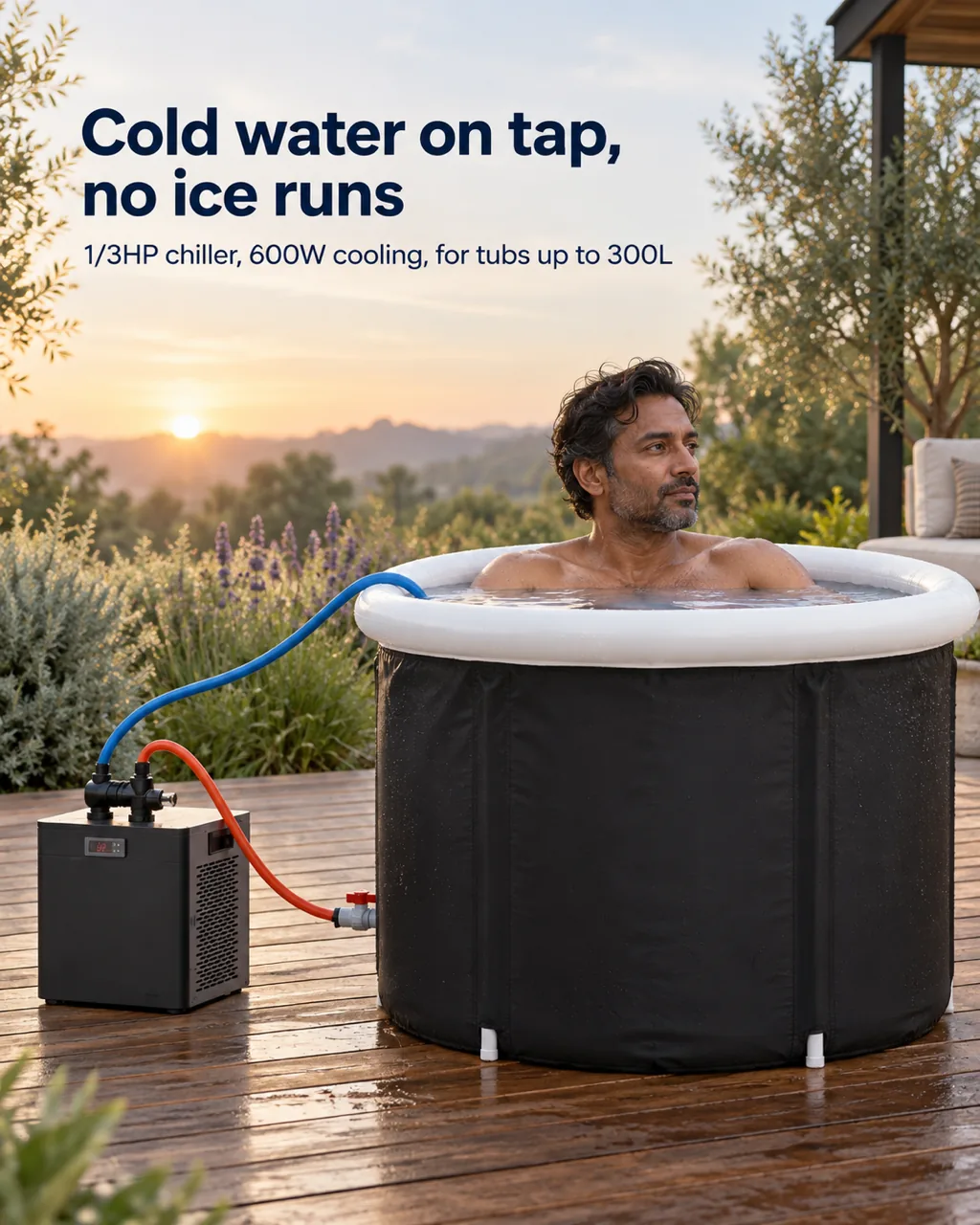
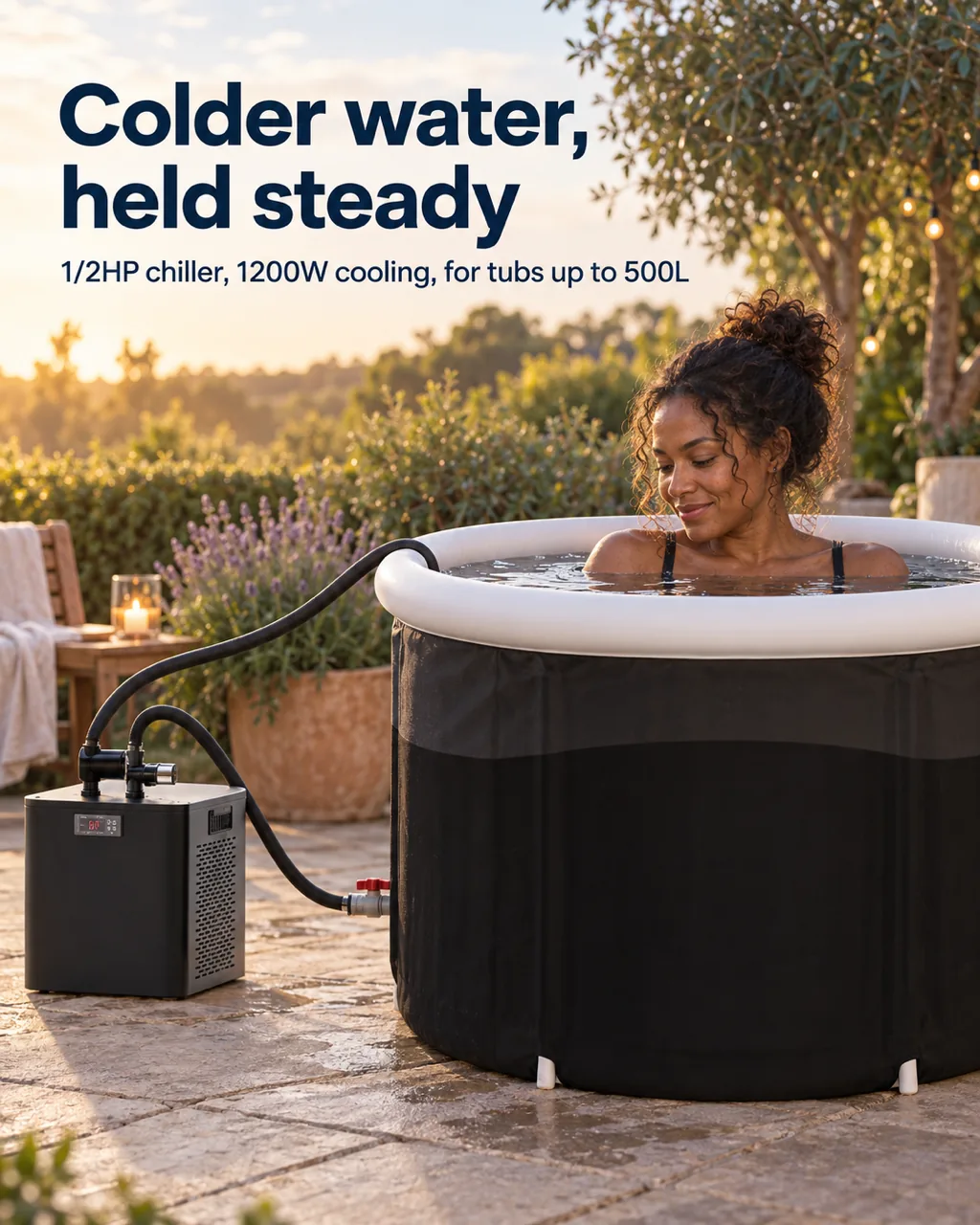
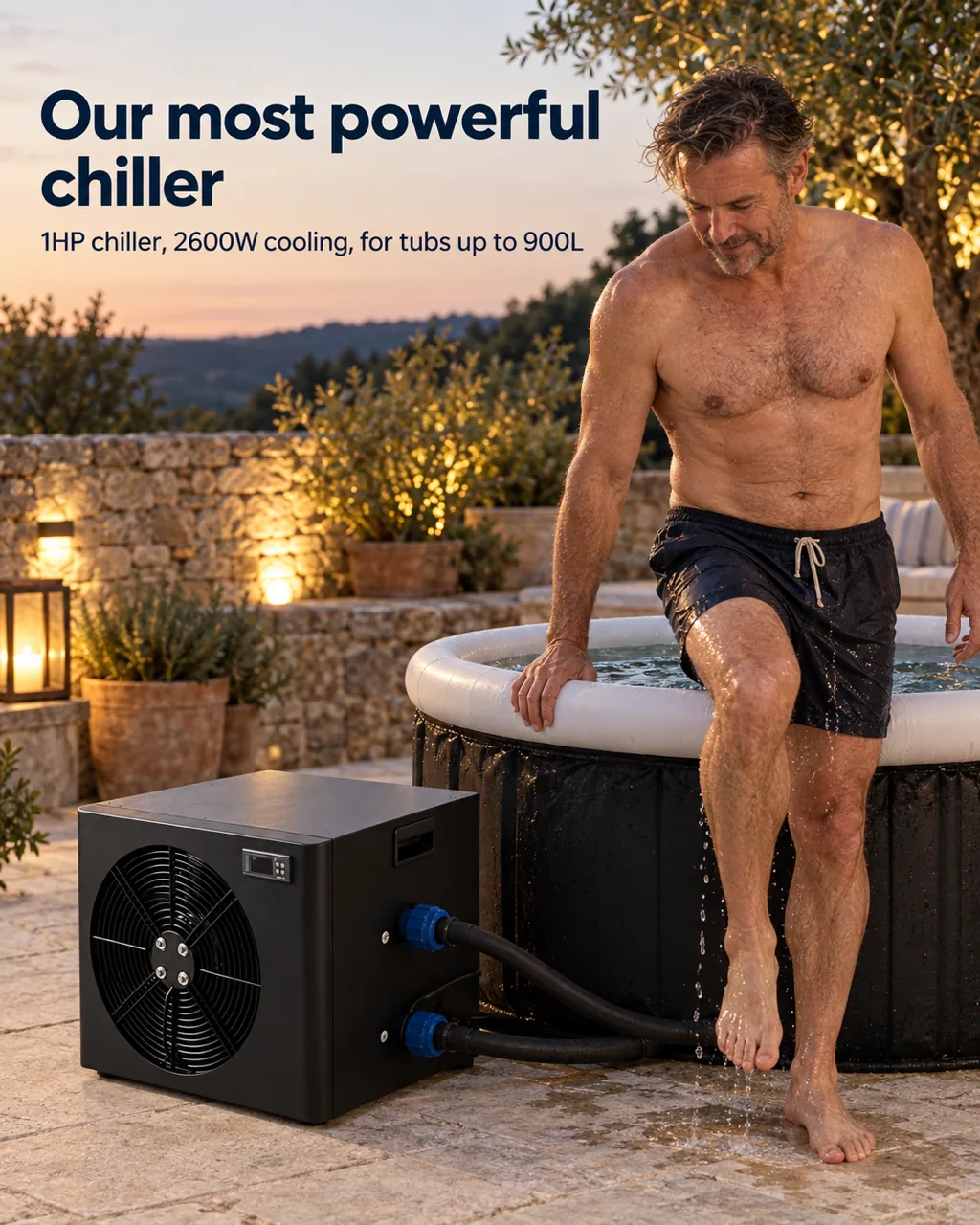
Horsepower (HP). This is the compressor size, and it's the shorthand most of the market uses. The Chill Core 300 is 1/3HP, the Chill Core 500 is 1/2HP and the Chill Core Pro is 1HP. Bigger compressor, more heat moved per hour, faster pull-down.
Cooling capacity in watts. This is the rate at which the unit removes heat from the water. The 300 is rated at 600W of cooling, the 500 at 1200W (double), and the Pro at 2600W (more than double again). This is not the electricity it draws from the wall. We come back to that in the running-cost section because people mix the two up all the time.
Maximum water volume. The litres figure above. It's the one to check against your tub first.
Minimum water temperature. The 300 cools to about 15°C, which the supplier also gives as 55 to 60°F. The 500 cools to about 4 to 9°C (39 to 49°F), and the supplier says where it lands in that band depends on whether it's indoors or outdoors. The supplier doesn't publish a minimum for the Pro, so we don't either.
Power supply. All three run on 220V/50Hz, so a normal UK socket. No special wiring.
Size and weight. The 300 is 29 × 29 × 32cm and 17kg gross. The 500 is 33.5 × 37 × 33.5cm and 28kg gross. The Pro is 45 × 36 × 37cm and 36kg gross. That last one is a two-person lift for most people, and it matters if the unit has to go up a flight of steps to a balcony.
The Chill Core 300 is the one we point beginners to. The supplier designed it for recreational users in medium to low-temperature climates, which describes most of the UK for most of the year. It holds a tub of up to 300 litres at about 15°C.
Is 15°C cold enough? For the recovery use most people have in mind, it's at the top of the range the research used. Machado and colleagues' 2016 meta-analysis in Sports Medicine pooled the cold water immersion trials on muscle soreness and reported that water between 10 and 15°C, for 10 to 15 minutes, showed the best results, with the authors' own conclusion narrowing that to 11 to 15°C. So the 300 gets you to the edge of that band rather than the middle of it. If you want to be at 11 or 12°C, or you want a proper shock, it isn't the model.
It also has a hard ceiling of 300 litres. That rules out the Plunge 320 unless you deliberately under-fill it, which most people won't do because a sit-in tub with less water in it is less pleasant. It suits a Plunge 80 filled below 300 litres, which is why it's the chiller in our Starter Bundle.
The supplier describes it as low-noise but doesn't publish a decibel figure. We won't make one up.
The Chill Core 500 is the step up, and honestly it's the one most of our customers should buy. Two things change. The rated volume goes to 500 litres, so it covers the Plunge 320's 380-plus litres with room to spare. And the minimum temperature drops to about 4 to 9°C, which puts you below the 11 to 15°C research band if you want to be there, and lets you sit comfortably inside it on a warm August afternoon when the 300 would be struggling.
The supplier positions the 500 for athletes and for hotter climates above 25°C, and describes it as faster to cool with a steady temperature once it gets there. The doubling of cooling capacity from 600W to 1200W is what does that. For a UK garden in July, when the tub sits in the sun all day, that headroom is what stops the water creeping up between sessions.
It weighs 28kg gross and measures 33.5 × 37 × 33.5cm, so it takes up about the footprint of a bedside cabinet next to the tub.
The Chill Core Pro is rated for up to 900 litres, with 2600W of cooling from a 1HP compressor and R410 refrigerant. That capacity is far beyond anything we sell as a tub. We stock it for people who already own a large barrel or a converted chest freezer setup, or who run two tubs and want one unit that laughs at the load.
Two honest notes. First, the supplier doesn't publish a minimum water temperature for the Pro, so we can't tell you how cold it goes. Second, at 36kg gross and 45 × 36 × 37cm it is a serious piece of kit to move. If your tub is a Plunge 320 in a normal garden, the 500 does the job and saves you £200.
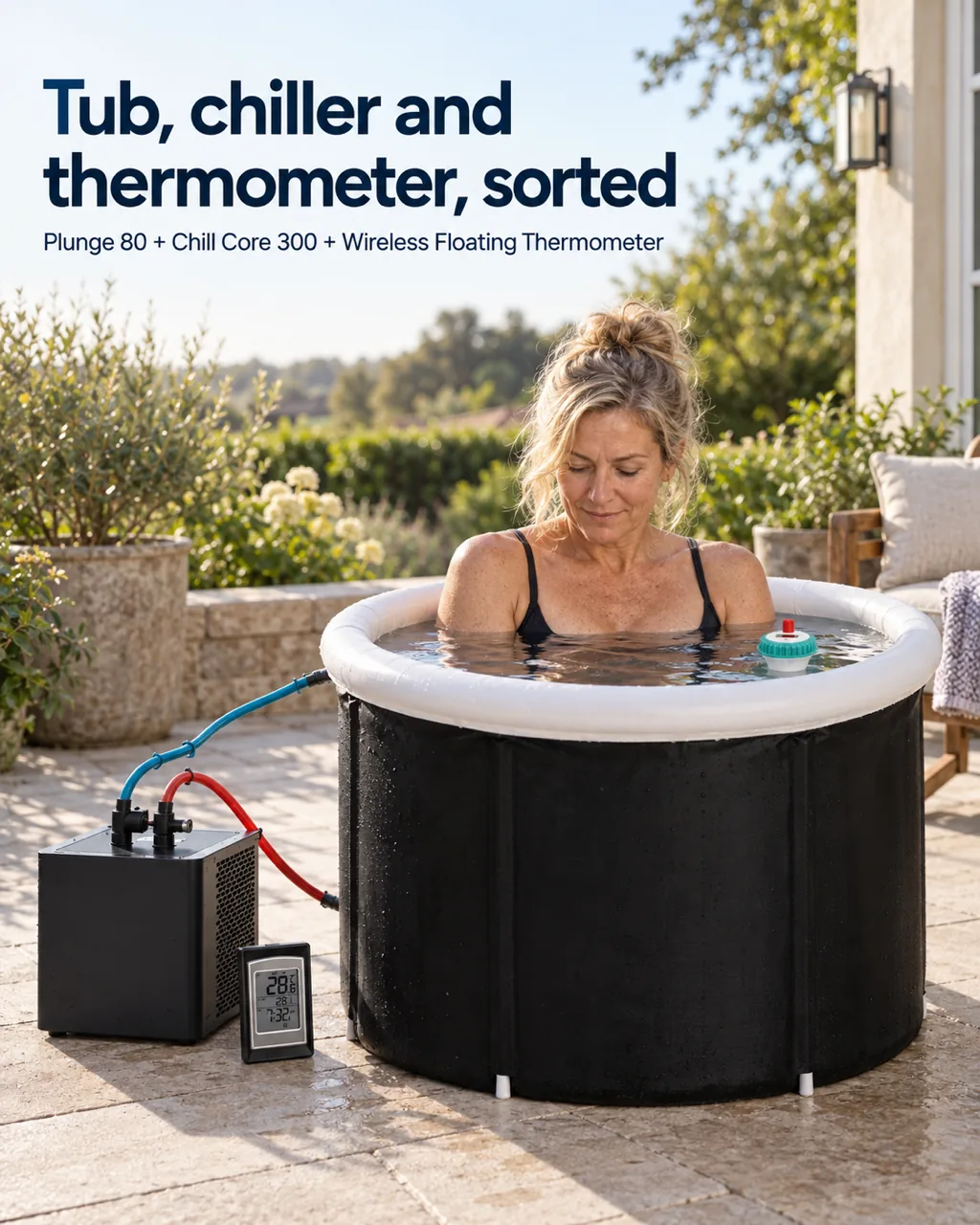
If you don't own a tub yet, the bundles are the sensible route, because the tub, chiller and thermometer are already matched.
The Starter Bundle is £649. It includes the Plunge 80 tub (80 × 75cm), the Chill Core 300 and a Wireless Floating Thermometer. Bought separately those come to £697, so the bundle saves £48. Fill the tub below 300 litres to stay inside the chiller's rating.
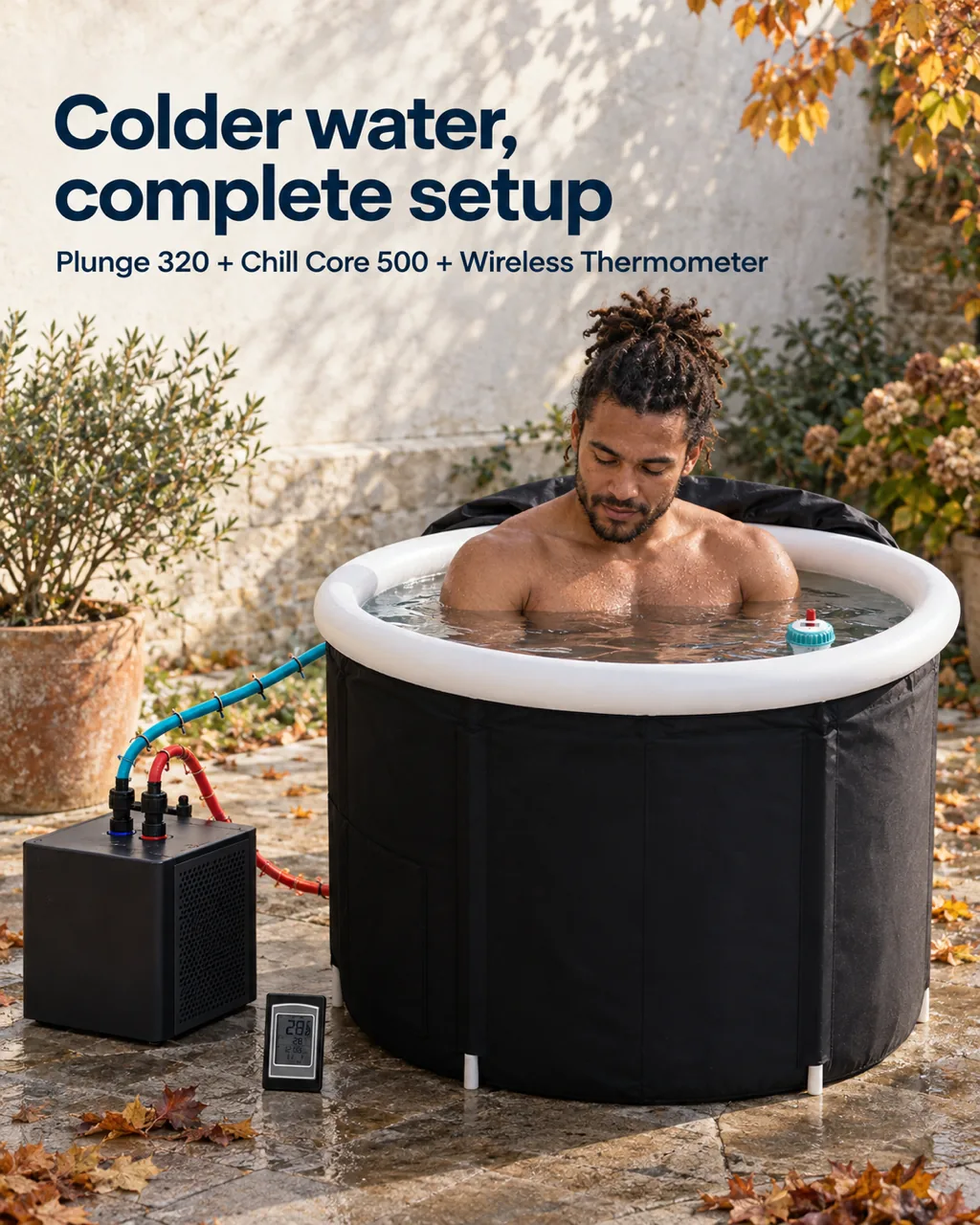
The Performance Bundle is £899. It includes the Plunge 320 (83 × 73cm, over 380 litres), the Chill Core 500 and the same thermometer. Separately that's £937, so you save £38. This is the setup we'd point to if you want water colder than the Starter Bundle can reach.
One practical thing about both: the items come from different suppliers, so they can arrive as separate parcels, each tracked. Bundle delivery is listed at 10 to 20 days.
This is where most chiller guides on the internet lose us. They quote a "£X per month" figure with nothing behind it. We won't, and here's why.
The supplier publishes cooling capacity in watts. That's heat removed from the water. It is not the electrical power the unit draws from the wall, which is a different, usually smaller, number that depends on the compressor's efficiency, the air temperature around the unit and how hard it's working. The supplier doesn't publish input wattage for any of the three models, so we don't have a number we can defend to you.
What we can give you is the method, and the one cited figure you need. Your running cost is the kilowatt-hours the chiller uses, read off a plug-in meter or your smart meter, multiplied by your electricity unit rate. Ofgem's price cap for 1 October to 31 December 2026 sets the electricity unit rate for a typical Direct Debit customer at 26.32p per kWh, with a 54.83p daily standing charge you pay anyway. So a unit that used 1 kWh in a day would add 26.32p to that day's bill. A £10 plug-in energy meter tells you the real number for your tub, your garden and your weather within a week, and that beats any estimate we could publish.
What you can control is the load. Three things make the biggest difference:
For a worked example of the method at UK electricity prices, our older chiller running-cost breakdown goes through it line by line.
People ask whether a chiller pays for itself against buying ice. We can show you the physics, and you can do the sums for your own habits.
Say you want to drop 300 litres of tap water by 5°C. Using the 4,184 joules per kilogram per degree figure, that's 300 × 4.184 × 5 = roughly 6,276 kJ of heat to remove. Ice does that by melting: each kilogram of ice absorbs 333.55 kJ as it turns to water at 0°C (Wikipedia, enthalpy of fusion), and then a bit more as that melt-water warms up to the tub temperature. Call it 375 kJ per kilogram all in. Divide 6,276 by 375 and you land around 17kg of ice for a single 5°C drop. That's most of a big bag from the supermarket, every session, before the water starts warming back up in the afternoon sun.
Do that four times a week and the receipts add up fast. Do it once a fortnight in January, when the tap water is already cold, and honestly the chiller is a luxury. Our do you need a chiller page goes deeper on that decision, and the ice bath vs chiller comparison puts the two side by side.
A few things we've learned that don't appear on any spec sheet.
Put the chiller on a firm, level surface, off the grass, with air space around it. It has a condenser that needs to breathe, and a unit jammed against a fence in full sun works harder than it should.
Plan the hose route before you fill. The chiller pulls water from the tub and returns it, so you'll have two hoses running between the two. A tub on decking with the chiller tucked under a bench is neat; a tub in the middle of the lawn with hoses across the path is a trip hazard. The chiller supplier doesn't list hoses or fittings in the box, so contact us before ordering if you need those confirmed.
Water care matters more with a chiller because the water stays in the tub for weeks rather than days. Our water care and maintenance guide covers filters, treatment and how often to change it. And check the temperature before you get in: a floating thermometer in the water is the number your body actually meets.
If you plunge once or twice a week, mostly from October to April, a cold tap in a UK garden already gets you a long way and a bag of ice does the rest. Spending £599 or more to save a few bags of ice a month doesn't add up, and we'd tell you that at the checkout.
It's also not for anyone without somewhere sensible to put it. A chiller needs a dry, level spot with airflow, a power supply that's safe outdoors, and hose runs to and from the tub. A tiny balcony where the tub already fills the floor may not have room for a 28kg box beside it.
And it's not a shortcut to colder-is-better. Bleakley and colleagues' 2012 Cochrane review pooled 17 trials with 366 participants and found some evidence that cold water immersion reduces delayed onset muscle soreness compared with rest, while rating the study quality as low. The Machado meta-analysis put the best results at 11 to 15°C. Nobody in that literature was chasing 2°C water. Buy the chiller for consistency and convenience, not for extremes.
Our chillers are covered by your consumer rights. If a unit arrives faulty or develops a fault, contact us and we'll arrange a repair, replacement or refund under the Consumer Rights Act. The supplier doesn't accept change-of-mind returns, so beyond that you have your legal 14-day right to cancel after delivery, with return postage at your cost. We'd rather you asked us the sizing question before you order than sent a 28kg box back.
Delivery on individual chillers is listed at 10 to 16 days, tracked, and free because every chiller is over the £100 free-delivery threshold. You'll get a tracking number by email when it ships.
For a Plunge 80 filled sensibly, or any tub under 300 litres, in a normal UK climate where 15°C water is cold enough: the Chill Core 300 at £599, or the Starter Bundle if you need the tub too.
For a Plunge 320, for anyone who wants water below 10°C, or for a tub that sits in the sun: the Chill Core 500 at £799, or the Performance Bundle at £899 with the tub and thermometer included.
For a tub over 500 litres, or two tubs on one unit: the Chill Core Pro at £999.
Whatever you pick, fill the tub, put the lid on, and let the chiller run overnight before your first session. Then put a plug-in meter on it for a week and you'll know your real running cost, which is more than we or anyone else can honestly promise you in advance.
This article is for general information and does not constitute medical advice. Cold water immersion carries cardiovascular and hypothermia risk. Consult a doctor before starting, never plunge alone, and stop immediately if you feel unwell.
This article is for general information and does not constitute medical advice. Cold water immersion is not a medical treatment. Consult a professional if you have cardiovascular conditions.
Match the chiller's rated water volume to the litres actually in your tub, with headroom. Our Chill Core 300 is rated by its supplier for up to 300 litres, the Chill Core 500 for up to 500 litres and the Chill Core Pro for up to 900 litres. The Plunge 320 holds over 380 litres (supplier figure), so it needs the 500 or the Pro. A Plunge 80 filled below 300 litres can run on the 300.
It depends on the model. The supplier rates the Chill Core 300 to about 15°C, and the Chill Core 500 to about 4 to 9°C depending on whether it runs indoors or out. The supplier does not publish a minimum temperature for the Chill Core Pro, so we don't quote one. For context, Machado and colleagues (2016) found the best soreness results in trials at 11 to 15°C.
We can't give you a pounds figure, because the supplier publishes cooling capacity in watts, not electrical input, and the two are different numbers. What we can give you is the method: kWh used on your meter multiplied by your unit rate. Ofgem's cap for 1 October to 31 December 2026 puts the Direct Debit electricity unit rate at 26.32p per kWh.
No. The point of a chiller is to take the water down to a set temperature and hold it there, so the bags of ice stop. Many people fill from a cold tap, switch the chiller on and let it work overnight before a first session.
If you plunge most days, yes, and the Starter Bundle (Plunge 80, Chill Core 300 and a thermometer for £649) is the cheapest way to do it. If you plunge once a week in winter, ice and a cold tap may be all you need. Read the running-cost section before you decide.
The supplier describes the Chill Core range as low-noise but publishes no decibel figure, so we don't quote one. All three models run on 220V/50Hz UK mains. Give the unit airflow around it and plan for the hoses and the drain before you pick the spot.
No, you don't need a chiller for an ice bath. Ice or a cold tap works. Here's when a chiller is worth it, when it isn't, and what ours cost and reach.
Cooling an ice bath with bags of ice vs running a chiller, side by side: what each costs up front and per session, the effort involved, and the temperature you get.
How to work out what an ice bath chiller costs to run at the UK electricity price cap: the one rate you need, worked sums per day and month, and what drives it.
Do you need an ice bath filter? What filters exist for home tubs, how often to change the water, and the sanitiser levels UK guidance uses, explained plainly.