Loading…
Guide
Ice bath thermometer: floating vs probe, and why it matters
10 min read
Of everything you can add to a plunge tub, the ice bath thermometer is the cheapest and the one that changes your sessions most. Not because a number makes the water colder, but because without one you're guessing, and guessing is how people end up either shivering in 6°C water thinking it's 12, or sitting in 17°C water wondering why it doesn't feel like much. This guide covers why the temperature matters, what the research actually used, the difference between floating and probe thermometers, and how our Wireless Floating Thermometer at £29 works.
Why does the temperature of an ice bath matter?
Because the research that shows any effect was done in a specific band, and your body's response changes a lot across a few degrees. Machado and colleagues' 2016 systematic review and meta-analysis in Sports Medicine pooled the cold water immersion trials on muscle soreness and reported that water between 10 and 15°C, for 10 to 15 minutes, showed the best results, with the authors' conclusion narrowing that to 11 to 15°C and 11 to 15 minutes. That's a five-degree window. Without a thermometer you can't tell whether you're in it.
It also matters for safety. Colder water is a bigger shock and a faster route to a drop in body temperature. Tipton and colleagues' 2017 review in Experimental Physiology looks at cold water immersion as a precursor to drowning, cardiac arrest and hypothermia as well as a treatment, and the NHS defines hypothermia as a dangerous drop in body temperature below 35°C, listing a fall into cold water among the causes. Knowing the water is 12°C rather than 4°C is part of managing that, not a nicety.
And it matters for consistency. If you plunge at "cold" on Monday and "cold" on Thursday, you have no idea whether those were the same session. Repeatability is how you learn what works for you, and a thermometer is what makes a session repeatable.
What the research used, and what it didn't
A quick tour so you can set your own target with the evidence in front of you.
The Machado meta-analysis is the one to anchor on: 10 to 15°C water, 10 to 15 minutes, best results within that band, no clear benefit from going colder or longer within the studied range. Bleakley and colleagues' 2012 Cochrane review, covering 17 trials and 366 participants, found some evidence that cold water immersion reduces delayed onset muscle soreness compared with rest, and rated the study quality as low. Between them, the honest summary is: a moderate effect on soreness, at moderate temperatures, from evidence that's not strong.
What the research did not do is chase 2°C water. Nobody in those trials was breaking ice off the surface. If you see a guide telling you colder is always better, it's not quoting this literature. Our cold plunge temperature guide and how long to stay in articles go deeper on both dials.
For your thermometer, that means the useful range is roughly 5 to 20°C: cold enough to cover a keen plunger's target, warm enough to tell you when a summer tub has drifted out of the band.
Floating vs probe thermometers
There are two kinds you'll see, and they suit different setups.
Floating thermometers
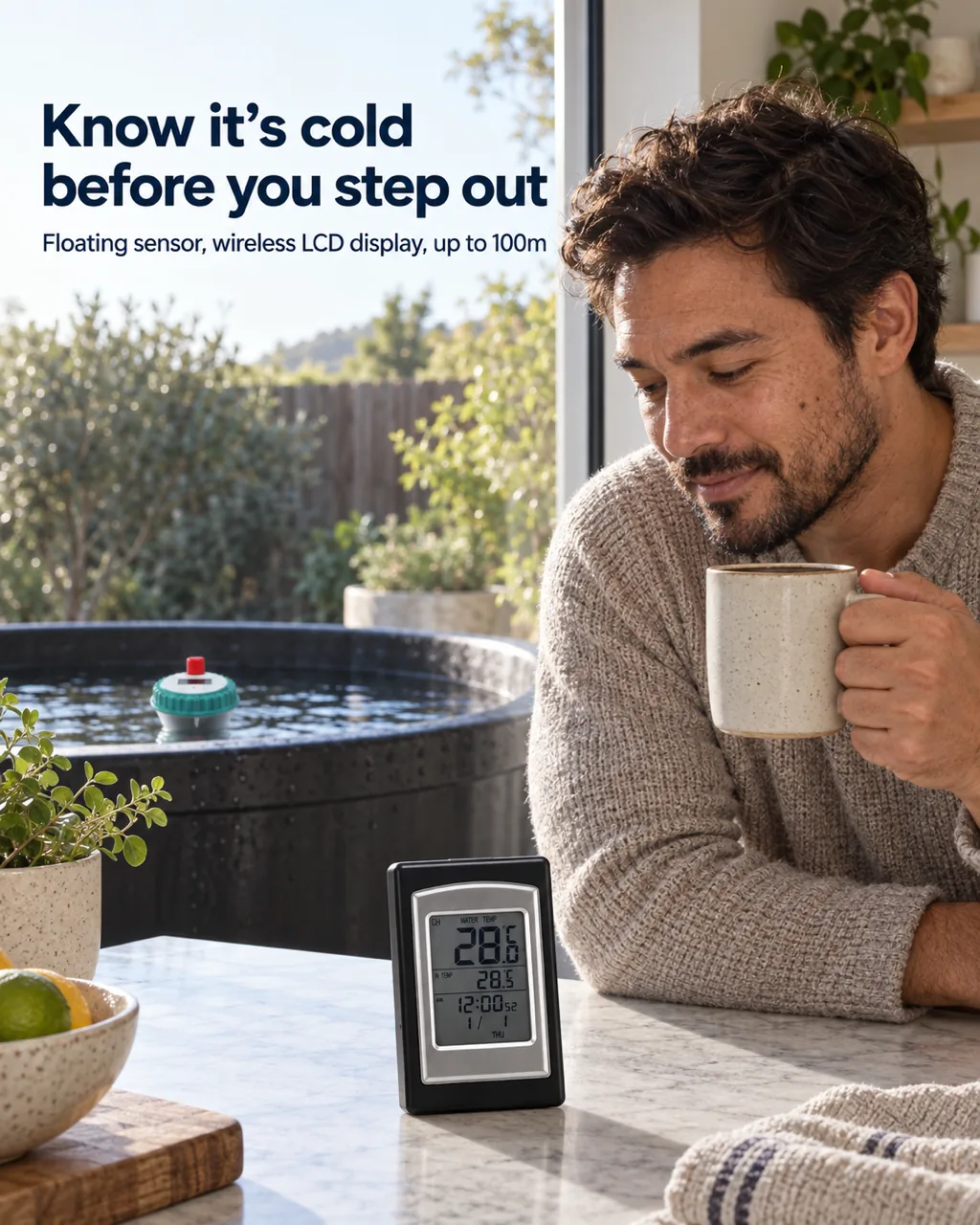
A sealed sensor in a buoyant housing that sits on the surface of the tub, reading the water around it continuously. The simplest are a glass or plastic dial you read by walking over and looking. The more useful kind is wireless: the float has a transmitter and sends the reading to a separate display you keep indoors.
Pros: always in the water, always reading, no need to go out and dip anything. With a wireless display you know the tub is ready before you put your coat on. Cons: it reads near the surface, so in a deep, unstirred tub it can differ a little from the water at your feet; and it needs batteries.
Probe thermometers
The kitchen type: a metal probe on a cable or a handle with a digital readout. You dip it in, wait a few seconds, read it, take it out.
Pros: accurate at the point you dip, cheap, and you may already own one. Cons: you have to go to the tub to use it, it only reads where you put it, and it's a spot check rather than a running record. Dropping it in the tub is a common way to lose one.
Which for an ice bath?
If you leave the tub filled between sessions, which most people do, floating and wireless is the answer. You want to glance at a display in the kitchen and know whether to add ice or wait. If you fill and drain every time, a probe is fine, and if you have one in the kitchen drawer, start there.
The Wireless Floating Thermometer, £29
Ours is the floating wireless kind. The floating sensor sits in the water and sends the reading over 433MHz to an LCD display, and the supplier rates the wireless range at up to 100m, which is plenty to reach from a garden tub to a kitchen windowsill. The display shows the water temperature alongside indoor temperature, the time and the date, and you can set a temperature alarm so it beeps when the tub hits your target.
Some details worth knowing before you order:
- Water range: -40 to 60°C. Far wider than any plunge, so it's happy in a tub with ice on it and in a warm bath if you ever want to use it that way.
- Up to three sensors. If you run two tubs, or want a second sensor in a paddling pool for the kids, one display pairs with up to three.
- Batteries: sensor 2 × AA, display 2 × AAA, not included. Add them to the shopping list.
- First use. Before you put it in the tub, tighten the sensor cap and hold it under water in a basin for a few minutes to make sure it's sealed. The supplier's instructions cover this, and it's the step people skip.
- Delivery: 22 to 40 days, tracked, with a tracking number by email. That's longer than our tubs, so if you're buying a tub too, the bundles avoid the wait mismatch by shipping it alongside.
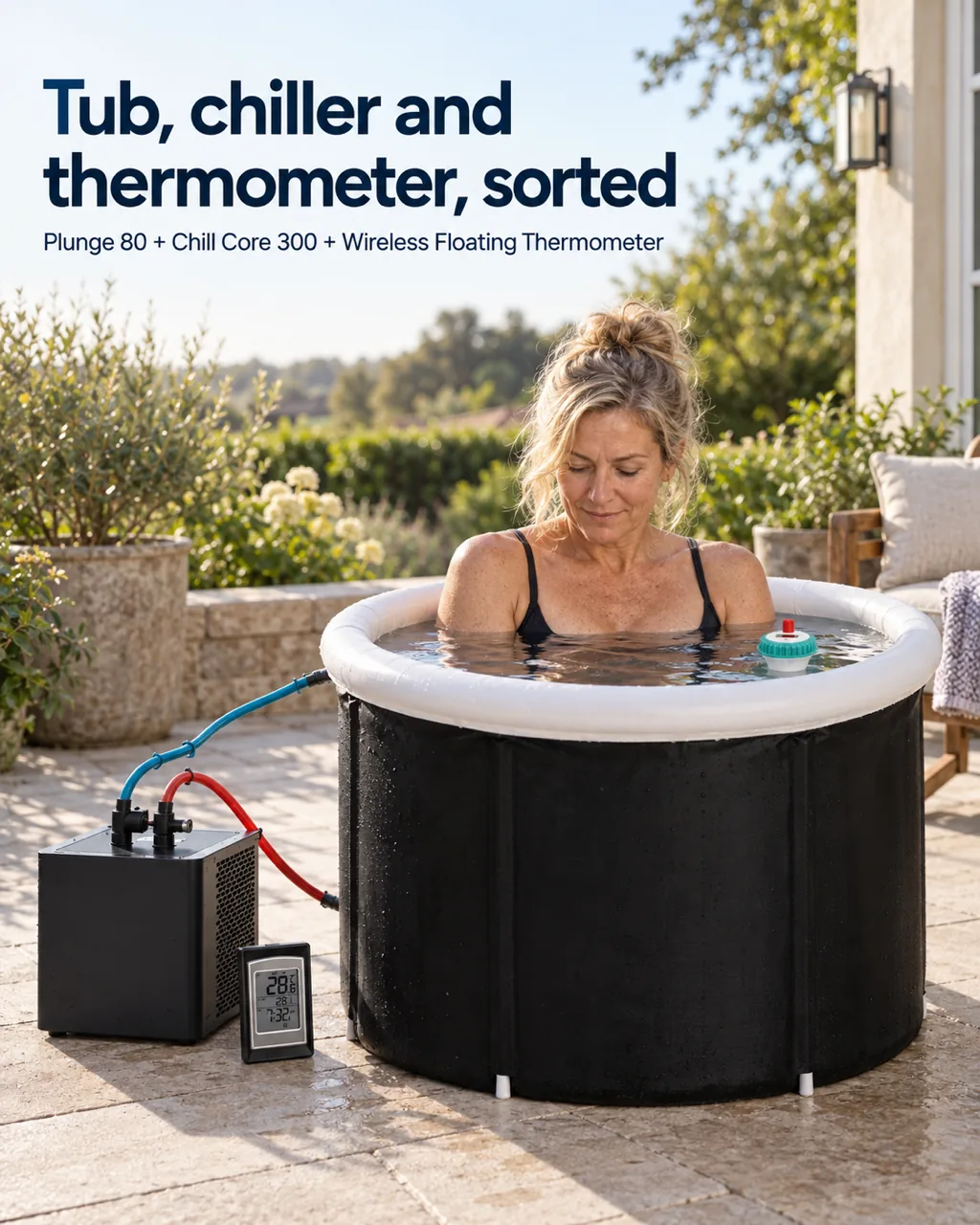
It's £29 on its own. It's also included in both bundles: the Starter Bundle at £649 (Plunge 80, Chill Core 300, thermometer) and the Performance Bundle at £899 (Plunge 320, Chill Core 500, thermometer). If you're buying a chiller anyway, the bundle price is lower than buying the pieces, and the thermometer is the thing that tells you the chiller's doing its job.
Where to put the sensor
Small thing, big difference. The float reads the water immediately around it, so where it sits in the tub matters.
Put it away from the chiller return if you run one, because the water coming back from the chiller is the coldest in the tub and will read low. Keep it out of direct sun; a black float in July heats up on top and can read a touch high even though the water underneath is fine. And keep it away from where you get in, so you're not sitting on it. Somewhere near the middle, in shade, with a lid over it, is about right.
If the tub has ice in it, the float will drift towards the ice and read the coldest patch. Push it away, stir, and wait a minute before you trust the number.
Before your thermometer arrives
Delivery on ours is listed at 22 to 40 days, so if you've ordered a tub and a thermometer separately you may be plunging before the display turns up. A few stopgaps.
A kitchen probe thermometer, dipped and stirred, gives a fair spot reading. A fridge thermometer on a string works too. A fish tank thermometer is cheap and reads the right range. What doesn't work is your hand: skin adapts within a minute or two and a tub that felt brutal on Monday feels fine on Friday at exactly the same temperature. That's the whole reason to own one.
And in the meantime, remember that a UK cold tap for most of the year is already near the top of the 10 to 15°C band. If you're plunging in tap water in the cooler months without ice, you're probably already close.
How to use a thermometer well
A few habits that make the number more useful.
Stir before you read. Cold water is denser and sinks, so an unstirred tub can be colder at the bottom than the surface. A quick swirl with your arm before you check gives a truer average. A chiller circulating the water does this for you.
Read the water, not the chiller. A chiller's display reads the water passing through it, which can lag or differ from the tub. The floating sensor in the tub is the number your body meets.
Let it settle after ice. Adding a bag of ice makes the surface reading drop fast while the bulk of the water hasn't caught up. Water is slow to change temperature, at 4,184 joules per kilogram per degree (Wikipedia, specific heat capacity), so a 380-litre tub takes a while to even out. Give it a few minutes and stir.
Use the alarm. Set it at your target and get on with your morning. When it beeps, the tub's ready.
Write it down. Temperature, time in, how you felt. After a month you'll know your own numbers, and that's worth more than any general guide.
Temperature targets by experience
Not medical advice; a sensible way to use the thermometer alongside the research.
First few weeks. Aim for the warm end, around 15°C, for short sessions. The point is getting used to the initial shock, not proving anything. A UK cold tap for much of the year is close to this on its own.
Settling in. Work down towards 12 to 13°C and towards the 10 to 15 minute window the trials used, as it becomes comfortable.
Established. The 11 to 15°C band the Machado authors concluded on. There's no evidence in that literature that going below 10°C does more for soreness, and there's more shock and more risk of getting too cold. If you go colder because you enjoy it, that's a choice, not a protocol.
Our beginner's routine sets this out week by week.
Who doesn't need this
If you fill from the tap, plunge straight away and drain immediately, a kitchen probe you already own does the job. If your chiller has a display and you trust it, you can manage without a second reading, though we'd still put a float in a big tub. And if you plunge in the sea or a lake, a wireless base station in the kitchen isn't much use; a simple dial float or a probe on a string is the tool there.
Where it's not optional, in our view: any tub you leave filled and top up with ice, any tub in the sun, and anyone still learning what 12°C feels like.
Looking after it
Rinse the sensor when you change the water, especially if you treat the water, and dry the cap threads before you reseal. Keep the display out of the rain; it's an indoor unit. Change the batteries when the display dims rather than when it dies, so you don't lose a morning's reading. Our water care guide covers what goes in the water and how that affects anything sitting in it.
The short version
The temperature band the research used is 10 to 15°C, and you can't know you're in it without a thermometer. A floating wireless one is the right kind for a tub you leave filled, and ours is £29: floating sensor, indoor display up to 100m away, alarm, -40 to 60°C range, batteries not included. Stir before you read, read the water not the chiller, and write the number down. It's the cheapest thing on our site and the one we'd buy first after the tub.
This article is for general information and does not constitute medical advice. Cold water immersion carries cardiovascular and hypothermia risk. Consult a doctor before starting, never plunge alone, and stop immediately if you feel unwell.
References
- 1.Machado AF, Ferreira PH, Micheletti JK, et al. (2016). Can Water Temperature and Immersion Time Influence the Effect of Cold Water Immersion on Muscle Soreness? A Systematic Review and Meta-Analysis. Sports Medicine.
- 2.Bleakley C, McDonough S, Gardner E, Baxter GD, Hopkins JT, Davison GW. (2012). Cold-water immersion (cryotherapy) for preventing and treating muscle soreness after exercise. Cochrane Database of Systematic Reviews.
- 3.Tipton MJ, Collier N, Massey H, Corbett J, Harper M. (2017). Cold water immersion: kill or cure? Experimental Physiology.
- 4.NHS. Hypothermia (a dangerous drop in body temperature below 35C).
- 5.Wikipedia. Specific heat capacity (water: 4184 J per kg per K).
This article is for general information and does not constitute medical advice. Cold water immersion is not a medical treatment. Consult a professional if you have cardiovascular conditions.
Frequently asked questions
Do I really need a thermometer for an ice bath?
You can plunge without one, but you'll be guessing. The trials Machado and colleagues (2016) pooled used water between 10 and 15°C; without a thermometer you have no idea whether you're at 8°C or 16°C, and the two feel different but are hard to tell apart on a cold morning. A £29 thermometer turns guessing into a repeatable number.
What temperature should an ice bath be?
The meta-analysis by Machado and colleagues (2016) found the best results for muscle soreness at water between 10 and 15°C, for 10 to 15 minutes, with the authors' own conclusion narrowing that to 11 to 15°C. You don't need ice-water extremes. Our temperature guide goes into the detail.
Floating or probe thermometer: which is better for an ice bath?
For a tub you leave filled, floating. It sits in the water all the time and reads continuously; the wireless kind sends the reading indoors. A probe thermometer is the kitchen type you dip in for a spot reading; accurate, but you have to go out to the tub to use it, and it reads where you dip it, not the whole tub.
How does the Wireless Floating Thermometer work?
The floating sensor sits in the tub and sends the water temperature over 433MHz to an LCD display up to 100m away, so you can keep the display in the kitchen. It shows water temperature, indoor temperature, time and date, and you can set a temperature alarm. It pairs with up to three sensors. Water range is -40 to 60°C.
What batteries does it need?
The sensor takes 2 × AA and the display 2 × AAA. Batteries are not included, so pick them up with the order.
Can I use a chiller's display instead of a thermometer?
The chiller reads the water passing through it, which is close but not the same as the water you're sitting in, especially in a big tub where the top and bottom differ. A floating thermometer in the tub is the number your body meets. The bundles include one for that reason.
Related products
Related reading
Ice bath temperature: how cold should a cold plunge be?
The ice bath temperature most studies used is 10 to 15°C (50 to 59°F). How cold an ice bath needs to be, where beginners start, and how much ice it takes.
How long should you stay in an ice bath? The 10 to 15 minute rule
How long should you stay in an ice bath: 10 to 15 minutes at 10 to 15°C is what the trials used. Shorter for beginners and colder water, with a timer set.
How to build a cold plunge routine: a beginner's protocol
Where to start, how fast to progress, and how to fit cold plunging around training without undoing your gains. A week-by-week plan grounded in the evidence.
Ice bath filter and water care: do you need a filter?
Do you need an ice bath filter? What filters exist for home tubs, how often to change the water, and the sanitiser levels UK guidance uses, explained plainly.