Loading…
You want a cheap ice bath and you'd like someone to tell you straight what the cheap one leaves out. Fair enough. Our lowest-priced tub is the Plunge 80 at £69, and this page is the honest version of the listing: what you get for the money, what you don't, what you'll end up adding, and the point at which the cheapest ice bath UK shoppers can buy stops being the cheapest way to plunge.
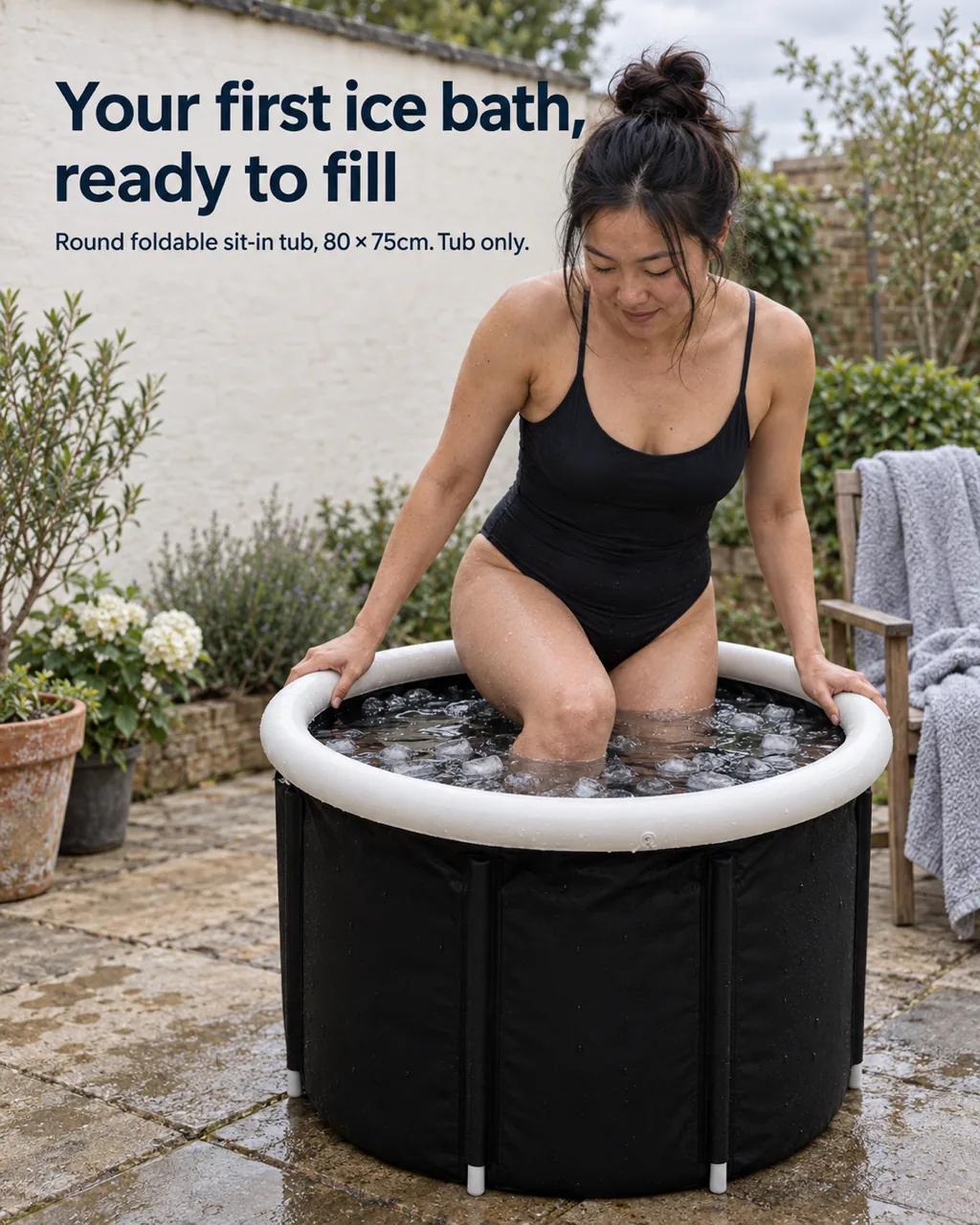
The Plunge 80 at £69 is the cheapest tub we'd put our name on. It's a round, foldable, sit-in cold plunge tub, 80 × 75cm according to the supplier, and it's the tub only: no lid, no accessories. Fill it from a cold tap, add ice if you want it colder, get in. That is the entire proposition and, for a lot of people, it's the right one. Where it stops being the right one is if you plunge often enough that the missing lid and insulation start costing you in ice and hassle, and we get to that below.
A proper sit-in tub. Not a bucket, not a paddling pool. At 80cm across and 75cm tall you sit with your knees up and the water comes up around your shoulders, which is how the cold water research was done: Machado and colleagues' 2016 meta-analysis pooled trials that immersed people at water between 10 and 15°C for 10 to 15 minutes, and found the best results for muscle soreness in that band. The Plunge 80 puts that much of you in the water.
A tub that folds. When you're done for the season it packs flat and goes in the shed. It goes through a door on its side, which matters more than it sounds if you're setting it up in a bathroom.
A tub with walls that hold their shape. This is a foldable fabric tub rather than an inflatable one, so it doesn't rely on air pressure to stand up and a pinprick doesn't empty it onto the patio. Our inflatable vs foldable guide covers that distinction properly.
And the cold. Which is the point, and which costs the same whatever you sit in.
This is the bit most cheap ice bath listings bury. Here's ours, in one place.
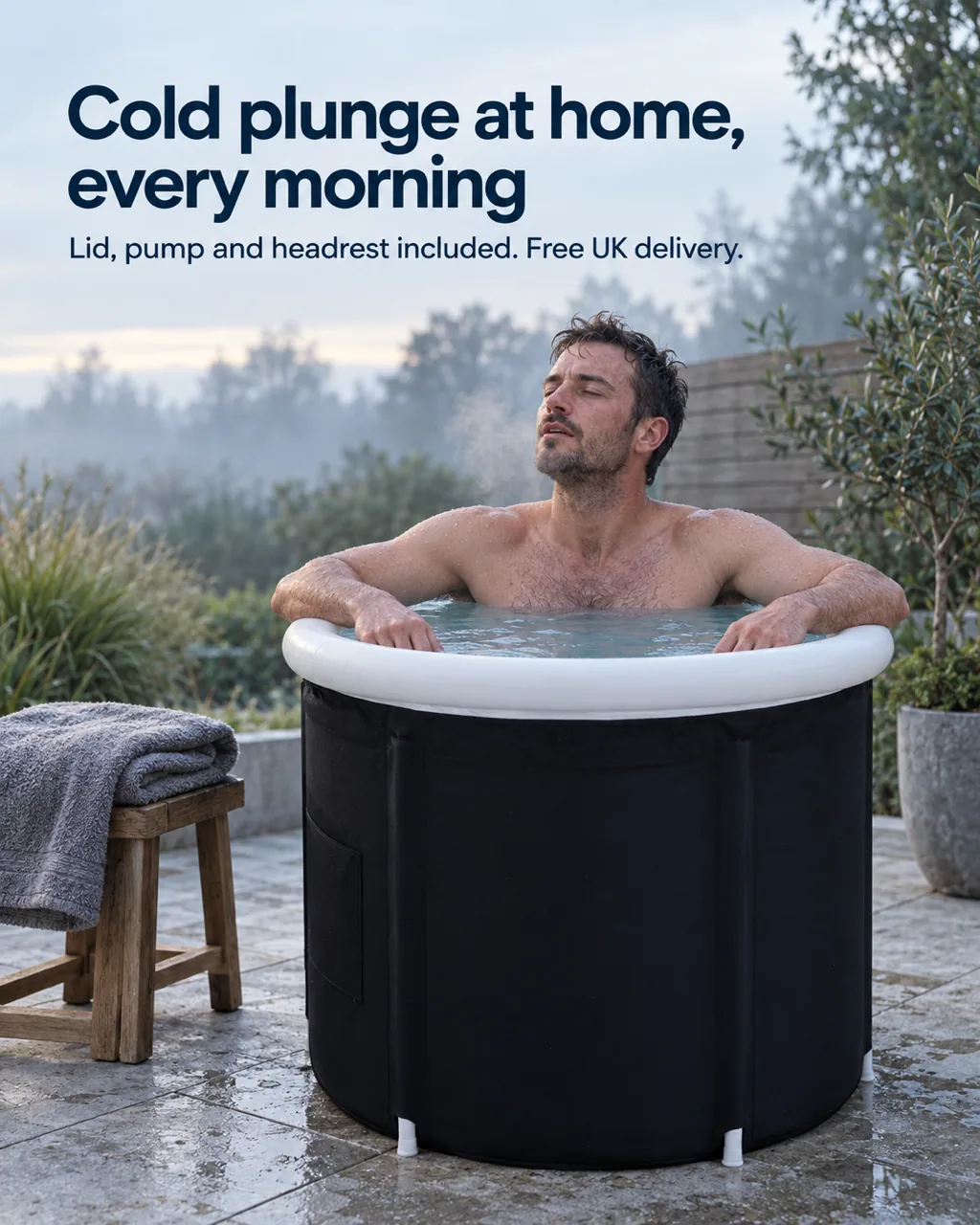
No lid. Between sessions the water is open to leaves, insects, rain and sun. The supplier's photo shows a lid, but the listing doesn't confirm one, so we don't promise it. You'll want to improvise a cover or plan to drain more often.
No pump. The Plunge 80 has no inflatable top ring to pump, so this one's a smaller loss than it sounds. But there's no headrest ring either, so the rim is plain fabric.
No drain hose. You empty it by siphon, by bailing, or by tipping, and tipping a tub is hard on seams and legs. A length of garden hose and a bit of patience does the siphon job.
No seat cushion. You sit on the base.
No insulation specified. The supplier lists the Plunge 80 as a round foldable sit-in tub. It's the Plunge 320 whose walls the supplier specifies as triple-layer insulated. That matters for how fast the water warms, which matters for how much ice you buy.
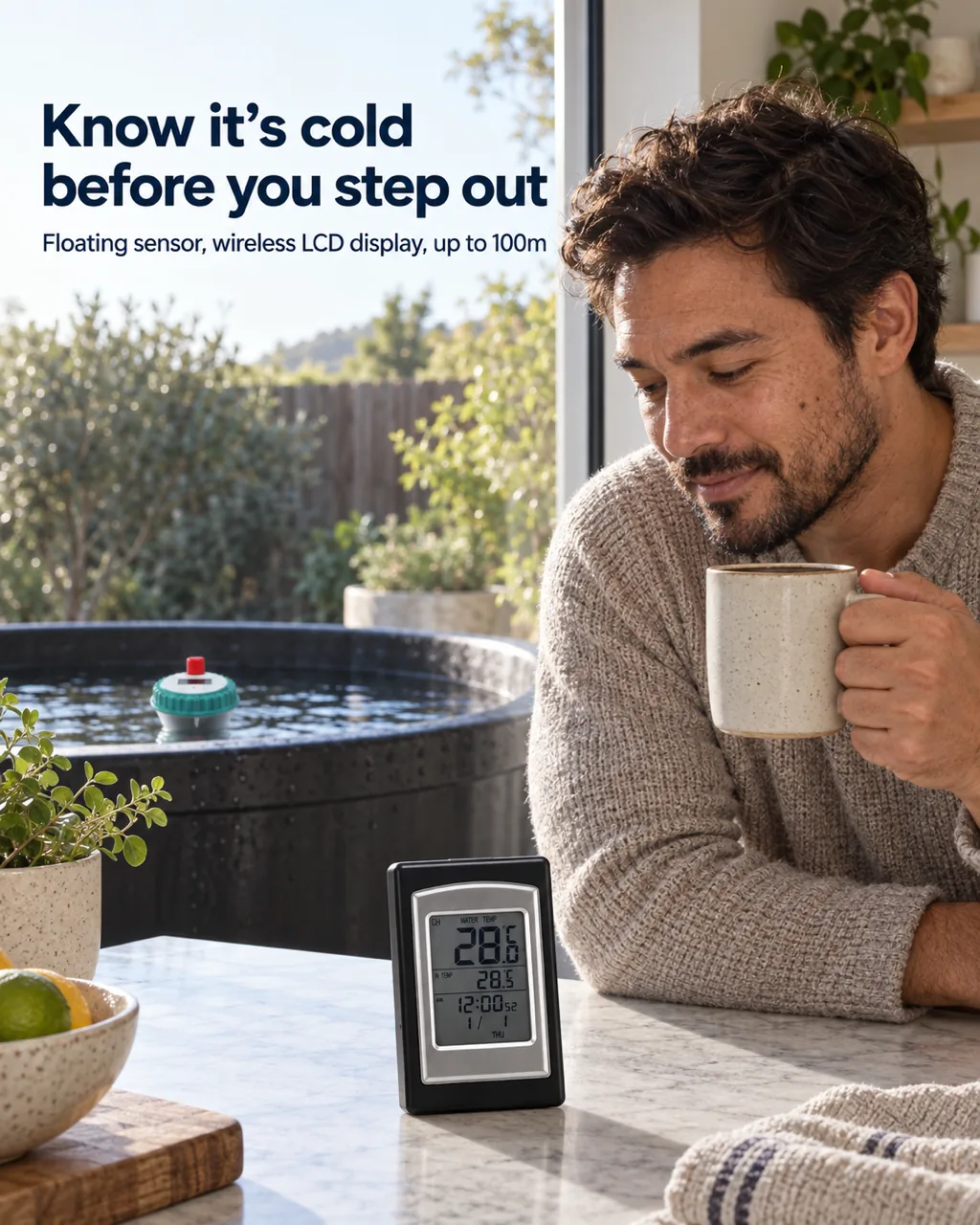
No thermometer. You'll be guessing, or dipping a kitchen probe. Our Wireless Floating Thermometer is £29 if you want the number without leaning over the tub.
No chiller. Nobody's cheap tub comes with one. A chiller is a separate £599-plus refrigeration unit and is a different decision entirely.
Delivery isn't free. Orders under £100 carry a flat £4.95 fee, shown at checkout before you pay. So the real number is £73.95 to your door.
Before you spend anything, it's worth knowing the free routes, because for some people they're enough.
Your bath. If you have one, a household bath filled from the cold tap with a couple of bags of ice is a real ice bath. The downsides are that it's indoors so you drip through the house, you can't leave it filled, and a standard bath is shallow so you're lying rather than sitting with water at the shoulders. But it costs nothing to try, and if you hate it you've learned that for the price of some ice.
A cold shower. Not the same thing, and we say so plainly in our ice bath vs cold shower article: a shower doesn't immerse you, so the body's response is different and the recovery trials weren't done that way. But as a way of finding out whether you can stand cold water at all, it's free and it's in your house.
A large storage box or a clean wheelie bin. People do this. It works in the sense that it holds cold water and you can get in it. It also tips over, has sharp edges, can't be drained without lifting it and looks like a bin. We'd rather you spent £69 on a tub with fabric walls and a flat base, but we'd be lying if we said the bin didn't work.
If any of those has you plunging three times a week for a month and enjoying it, you're a plunger and the £69 is money well spent. If none of them appeals, no tub will change that.
The honest cost of a cheap ice bath isn't the tub. It's the ice, and the ice depends on insulation and a lid.
Two textbook figures do the sums. Water takes 4,184 joules per kilogram to change by one degree (Wikipedia, specific heat capacity). Ice absorbs 333.55 kJ per kilogram as it melts (Wikipedia, enthalpy of fusion), plus a little more as the melt-water warms to the tub temperature; call it around 375 kJ per kilogram all in. Say you've got 250 litres in the Plunge 80 and you want to drop it by 4°C: 250 × 4.184 × 4 = about 4,184 kJ, divided by 375 is roughly 11kg of ice. That's a large bag or two from the supermarket for a single cool-down.
Now the part that depends on the tub. If the water warms back up by two degrees between sessions, the uninsulated, uncovered tub needs roughly 5 to 6kg of ice just to get back to where it was, before you cool it any further. An insulated tub with a lid warms more slowly. Over a summer of regular plunging, that difference is a lot of bags, and it's the real argument for spending more up front.
In winter, none of this applies. A UK cold tap in January may already be inside the 10 to 15°C band on its own, and the cheap tub is simply the right tool. It's the July plunger who pays for the missing lid.
The Plunge 320 is £109, so £40 more than the Plunge 80. Here's exactly what the £40 buys, from the supplier's listing:
Price a lid, a hose and a cushion separately and you're most of the way to £40 before you've touched the insulation, and the £4.95 delivery fee disappears too. So the honest arithmetic is that the Plunge 80 is cheaper if you'll use it as-is, occasionally, and the Plunge 320 is cheaper if you'd otherwise buy the missing pieces. Our Plunge 80 vs Plunge 320 comparison puts the two side by side line by line.
What we'd say to a friend: if you're not sure you'll stick with it, buy the 80. If you already know you will, buy the 320 and skip the tarp-and-bungee-cord phase.
If you've bought the Plunge 80 and want to keep it cheap, this is what works.
Cover. A tarp weighted at the edges, or a fitted garden furniture cover from a DIY shop. It won't seal like a proper lid but it keeps the leaves out and the sun off.
Drain. Garden hose, siphon started with the tap, run downhill. Or a cheap submersible pump if the only drain is uphill.
Ice. Supermarket bags are the convenient option. Freezing water in old ice cream tubs and drinks bottles is nearly free if you plan a day ahead and have freezer space; a few large blocks melt more slowly than the same weight of cubes.
Shade. Put the tub against a north-facing wall or under a tree. Free insulation.
Fill level. Less water means less to cool. Fill to shoulder height sitting down, not to the rim.
Timing. Plunge early in the morning when the water is coldest after a night outdoors.
None of these cost more than a few pounds and together they close a fair bit of the gap to a lidded, insulated tub.
Whatever you spend, the water is the same and so are the risks. Tipton and colleagues' 2017 review in Experimental Physiology looks at cold water immersion as a precursor to drowning, cardiac arrest and hypothermia as well as a treatment, and describes cold water as threat or treatment depending on circumstance. Ease in over weeks rather than days, never plunge alone, have warm clothes within reach, and get out the moment anything feels wrong. Our beginner's cold plunge routine sets out a sensible progression, and a cheap tub is exactly the right place to follow it.
On the benefits side, keep expectations where the evidence is. Bleakley and colleagues' 2012 Cochrane review, covering 17 trials and 366 participants, found some evidence that cold water immersion reduces delayed onset muscle soreness compared with rest, and rated the study quality as low. That's what you're buying: a chance at less soreness and a habit some people enjoy. Not a cure for anything, at any price.
If you want it to look nice, it won't; it's a fabric tub without a rim ring, and it looks like one. If you want to lie flat, it's a sit-in tub. If you're tall and broad, 80cm across is snug; measure yourself sitting with your knees up before ordering. If you plan to plunge daily through the summer, the ice bill will make you wish you'd bought the lidded tub. And if you're going to pair it with a chiller, the Starter Bundle at £649 puts the Plunge 80 with the Chill Core 300 and a thermometer for £48 less than buying them separately, which is a better way to do it than buying the tub alone first.
Tracked delivery, listed at 10 to 16 days, with a tracking number by email when it ships. Under £100 the flat fee is £4.95.
On returns, the law is the floor and the ceiling here. You can tell us within 14 days of receiving the tub that you want to cancel, you then have 14 days to return it, and the refund is due within 14 days of it coming back to us (GOV.UK, accepting returns and giving refunds). Return postage is at your cost. Our supplier doesn't accept change-of-mind returns beyond that. If it arrives faulty or damaged, we replace or refund it.
The Plunge 80 at £69 is a real sit-in tub at the lowest price we can sensibly offer, and it's the right buy if you're testing the water or you plunge occasionally in the cooler months. It doesn't include a lid, a hose, a cushion, insulation or a thermometer, and delivery adds £4.95. If you'd buy any three of those things anyway, the Plunge 320 at £109 is the cheaper tub. Either way, the cold is the same, and it's the cold you're paying for.
This article is for general information and does not constitute medical advice. Cold water immersion carries cardiovascular and hypothermia risk. Consult a doctor before starting, never plunge alone, and stop immediately if you feel unwell.
This article is for general information and does not constitute medical advice. Cold water immersion is not a medical treatment. Consult a professional if you have cardiovascular conditions.
The cheapest tub we sell is the Plunge 80 at £69: a round, foldable, sit-in cold plunge tub of 80 × 75cm according to the supplier, with no lid or accessories. Cheaper inflatables exist elsewhere; we haven't priced them today so we don't quote figures, and they come with their own trade-offs.
No lid, no pump, no drain hose, no seat cushion, no headrest ring, no thermometer and no chiller. It is the tub only. The supplier's photo shows a lid but the listing doesn't confirm one, so we don't promise it.
For finding out whether you like cold water, yes. Cold water at 12°C is the same in a £69 tub as in a £2,000 one. The money you don't spend goes on insulation, a lid, rigidity and convenience, not on the cold.
Depends on the tap temperature and how cold you want it. As a worked example using textbook figures, dropping 250 litres by 4°C takes roughly 11kg of ice. In winter a UK cold tap may need none. In summer it needs a fair bit, and that's where a lid and insulation start paying for themselves.
If you'll plunge more than once a week, probably. The Plunge 320 at £109 adds triple-layer insulated walls, an all-weather lid, six legs, a seat cushion, hand pump, drain hose and seal ring, and it clears the £100 free-delivery line. Buy those bits separately and the gap shrinks fast.
Your legal right applies: tell us within 14 days of receiving it, return it within 14 more, refund within 14 days of it arriving back (GOV.UK). Return postage is at your cost. Our supplier doesn't accept change-of-mind returns beyond that. Faulty or damaged, we replace or refund.
Ice bath cost in the UK, all in: the tub, ice or a chiller, electricity, water and small parts. How much an ice bath costs in year one, with worked sums.
Aldi ice bath review for 2026: the £24.99 Bestway-style inflatable and the £149.99 Crane Premium, what Aldi states, and when a £69 tub makes more sense.
Where to start, how fast to progress, and how to fit cold plunging around training without undoing your gains. A week-by-week plan grounded in the evidence.
Setting up a home ice bath: the tub, a thermometer and optional chiller, where it goes indoors or out, and what an ice bath at home costs, with real prices.