Loading…
Type "inflatable ice bath" or "blow up ice bath" into a search box and you'll get pages of paddling-pool-shaped tubs at tempting prices. Type "foldable ice bath" and you'll get tubs that look similar in the photo but are built quite differently. This guide is the inflatable ice bath vs foldable comparison we wish we'd read before we started: how each one is made, how each holds cold, what breaks, and which one to buy for which sort of person. We sell the foldable kind, starting with the Plunge 80 at £69, so read this knowing where we stand and check our reasoning.
If you're going to plunge more than once a week, buy the foldable one. Its walls hold their shape with fabric and rigid supports rather than air, so it doesn't sag when you lean on it, a pinprick doesn't flood the patio, and the good ones are insulated so your ice lasts longer. An inflatable ice bath is the cheaper, lighter, smaller-packing option, and it's fine for a trial or for the occasional summer dip. That's the whole verdict. The rest of this page is why.
An inflatable ice bath is a tall ring of air chambers, sometimes with a separate inflatable floor, made from PVC or a similar coated fabric. You pump it up, fill it with water, and the air pressure inside the walls holds the water in. It's the same principle as a paddling pool or an inflatable hot tub, just taller and narrower so you sit upright in it.
Its virtues are real. It weighs very little. It packs into a bag not much bigger than a sleeping bag. It's the cheapest way to get a body of cold water you can sit in. And there's no assembly beyond pumping.
Its weaknesses come from the same source: air. Air compresses, so the walls give when you push against them, and getting in and out means bracing on a rim that moves. Air leaks, slowly through valves and seams and quickly through a puncture, and a tub that's lost pressure with 300 litres in it folds over and empties itself. And air-walled tubs almost never have a dedicated insulating layer, because the air chamber is doing the structural job, not the thermal one.
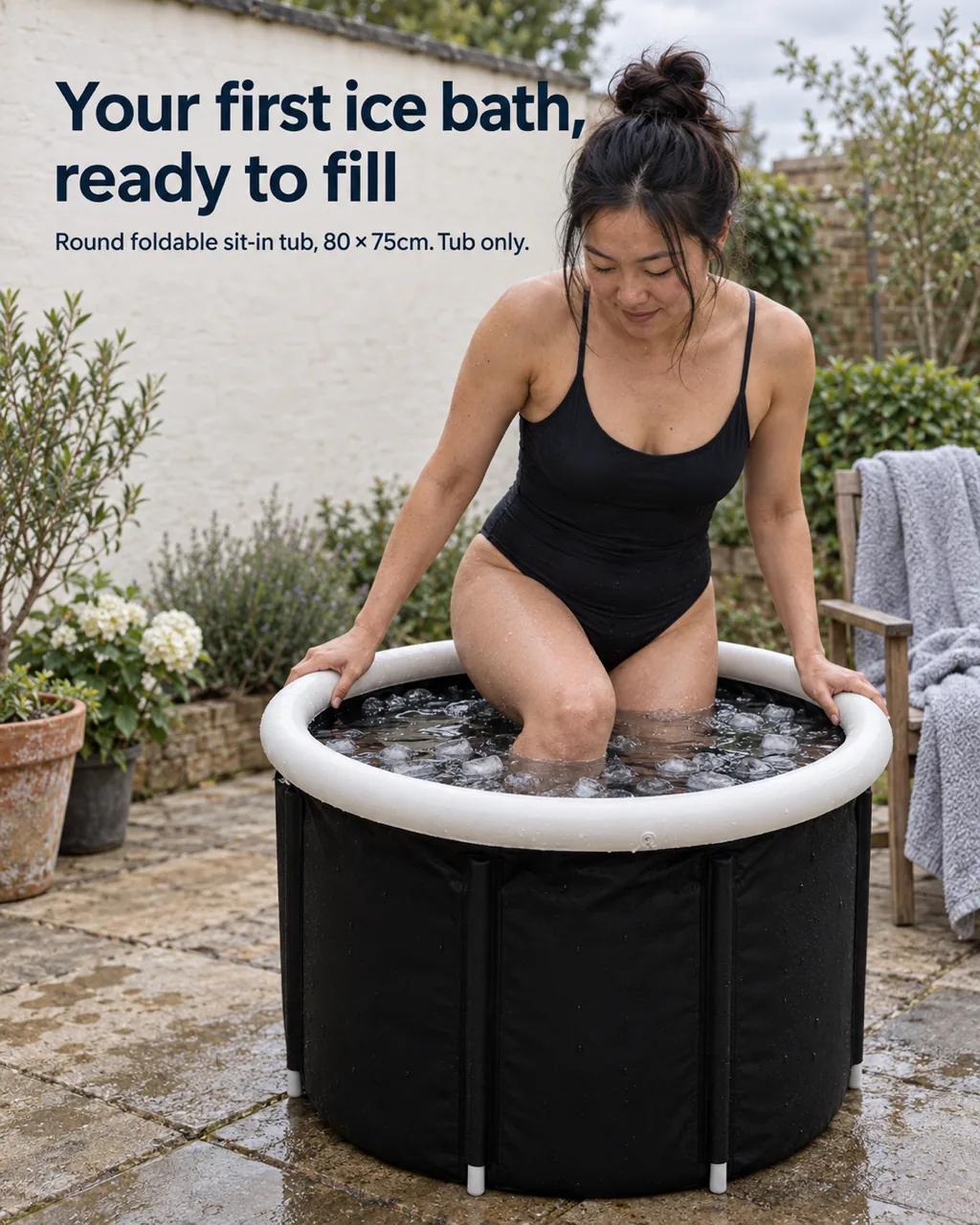
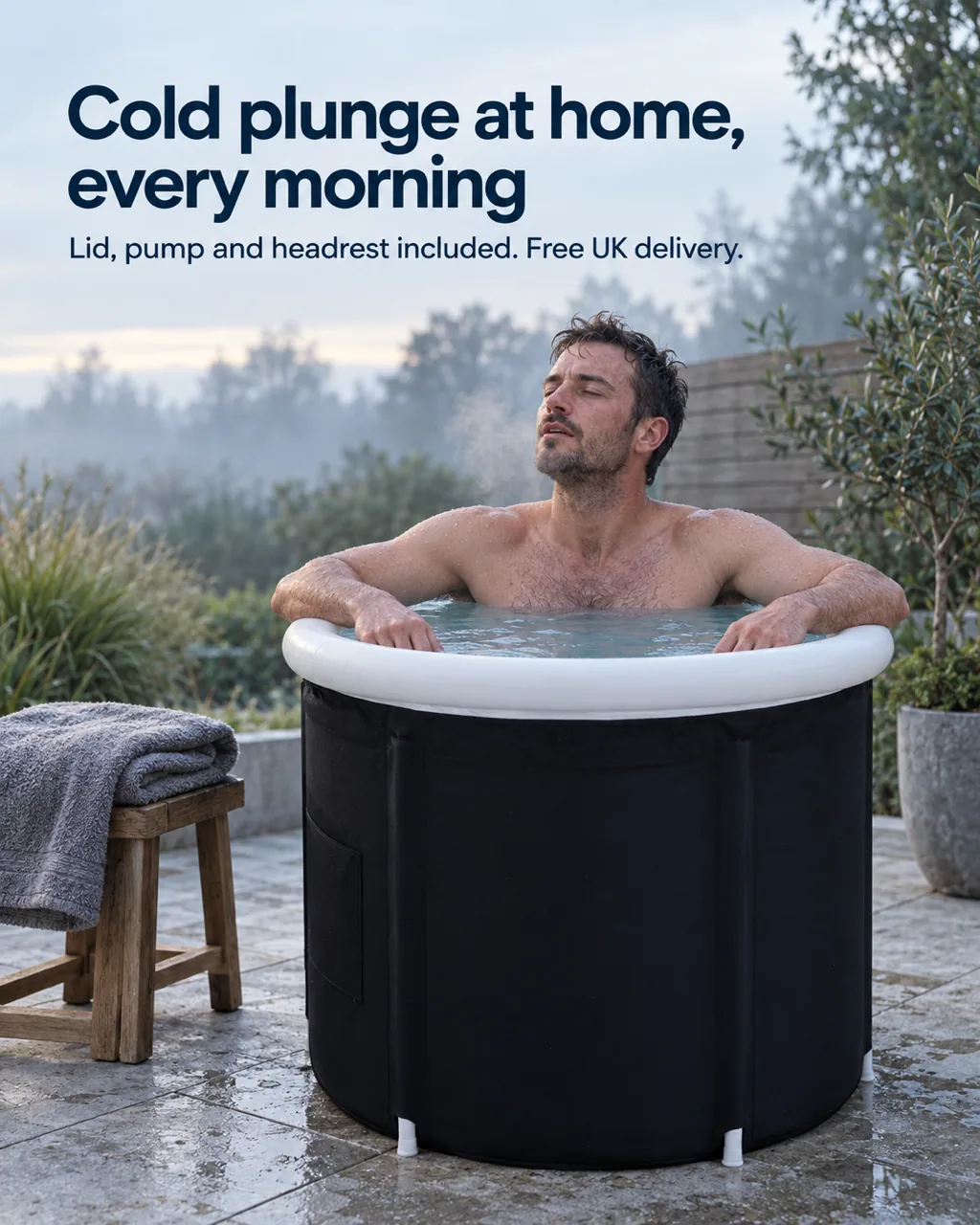
A foldable ice bath keeps the fabric but changes what holds it up. The wall is a multi-layer fabric sheet, and the structure comes from rigid supports: either poles that slot into sleeves or legs that clip on around the outside. The Plunge 80 is a round foldable sit-in tub of 80 × 75cm according to its supplier. Its bigger sibling, the Plunge 320, uses six support legs, and its walls are triple-layer insulated fabric with an inflatable ring only at the top, which forms the rim and doubles as a headrest.
So there is still a bit of inflating with most foldable tubs, but only the top ring. If that ring loses pressure the rim gets soft; the tub doesn't collapse, because the legs are holding it.
The trade-offs run the other way from inflatables. A foldable tub is heavier and folds into a flatter, wider bundle rather than a small bag. There's five minutes of assembly. It costs more than the cheapest inflatable. In return you get a wall you can lean on, a tub that doesn't rely on a valve holding, and on the insulated models, water that stays cold much longer.
This is where the two types really separate, and it comes down to physics you can check.
Water is hard to cool and, once cold, hard to warm back up. It takes 4,184 joules to change one kilogram of water by one degree (Wikipedia, specific heat capacity), and one litre of water weighs almost exactly one kilogram (Wikipedia, litre). So a tub with 300 litres in it that's sitting at 12°C is holding a lot of "cold" relative to the 18°C air around it. The only question is how fast the air, the ground and the sun steal it back.
An air-walled inflatable gives the heat an easy route. There's a thin skin, a pocket of air, another thin skin, and then the water. An insulated foldable tub puts a deliberate insulating layer in the wall, which slows the transfer, and a lid on top stops the warm air and sunshine getting at the surface, which is where most of the loss happens.
The consequence shows up as ice. Each kilogram of ice absorbs 333.55 kJ as it melts (Wikipedia, enthalpy of fusion). If your tub warms by two degrees between Tuesday and Thursday, that's 300 × 4.184 × 2 = about 2,510 kJ to remove, which is roughly 7kg of ice just to get back to where you were, before you cool it any further. A tub that only warmed by one degree over the same two days needs half that. Over a summer, the insulated tub pays for the price difference in ice.
We should be honest that the Plunge 80 is the essential model and the supplier lists it simply as a round foldable sit-in tub; it's the Plunge 320 whose walls the supplier specifies as triple-layer insulated. If holding cold in July is your priority, the 320 is the one for that.
Talk to anyone who's owned both and the failure stories line up.
With inflatables: slow leaks at the valve that mean pumping up before every session; a puncture from a cat, a bramble or a dropped thermometer; walls that go soft in cold weather because the air inside contracts as it cools; and the rim folding when you put your weight on it to climb out. None of these are dramatic. All of them are annoying, and the puncture one is a wet patio.
With foldable tubs: the top ring needs pumping occasionally; legs that aren't seated properly make the tub lean; and fabric wears eventually at the fold lines if you fold it up wet and leave it. The manual covers assembly and storage, and reading it first avoids most of this. A drain hose and a seal ring come with the Plunge 320, and using them rather than tipping the tub over is kinder to the seams.
Neither type is a lifetime purchase the way a steel tub is. The foldable type is the one you're more likely to still be using in year two, and if you do wear one out, the replacement cost is a tub, not a tub plus a chiller plus a patio full of accessories that only fit the old one.
Sticker prices are where inflatables win, and they win by a fair margin against branded foldable tubs. We haven't priced inflatable tubs today, so we won't quote figures, but they are the cheapest category of tub you can buy.
Against that, our foldable Plunge 80 is £69, which puts it in the same conversation as many inflatables rather than a class above. That price is for the tub only, no lid or accessories, and orders under £100 carry a flat £4.95 delivery fee shown at checkout. The Plunge 320 at £109 adds the insulated walls, the lid, the six legs, the seat cushion, the hand pump, the drain hose and the seal ring, and clears the free-delivery threshold.
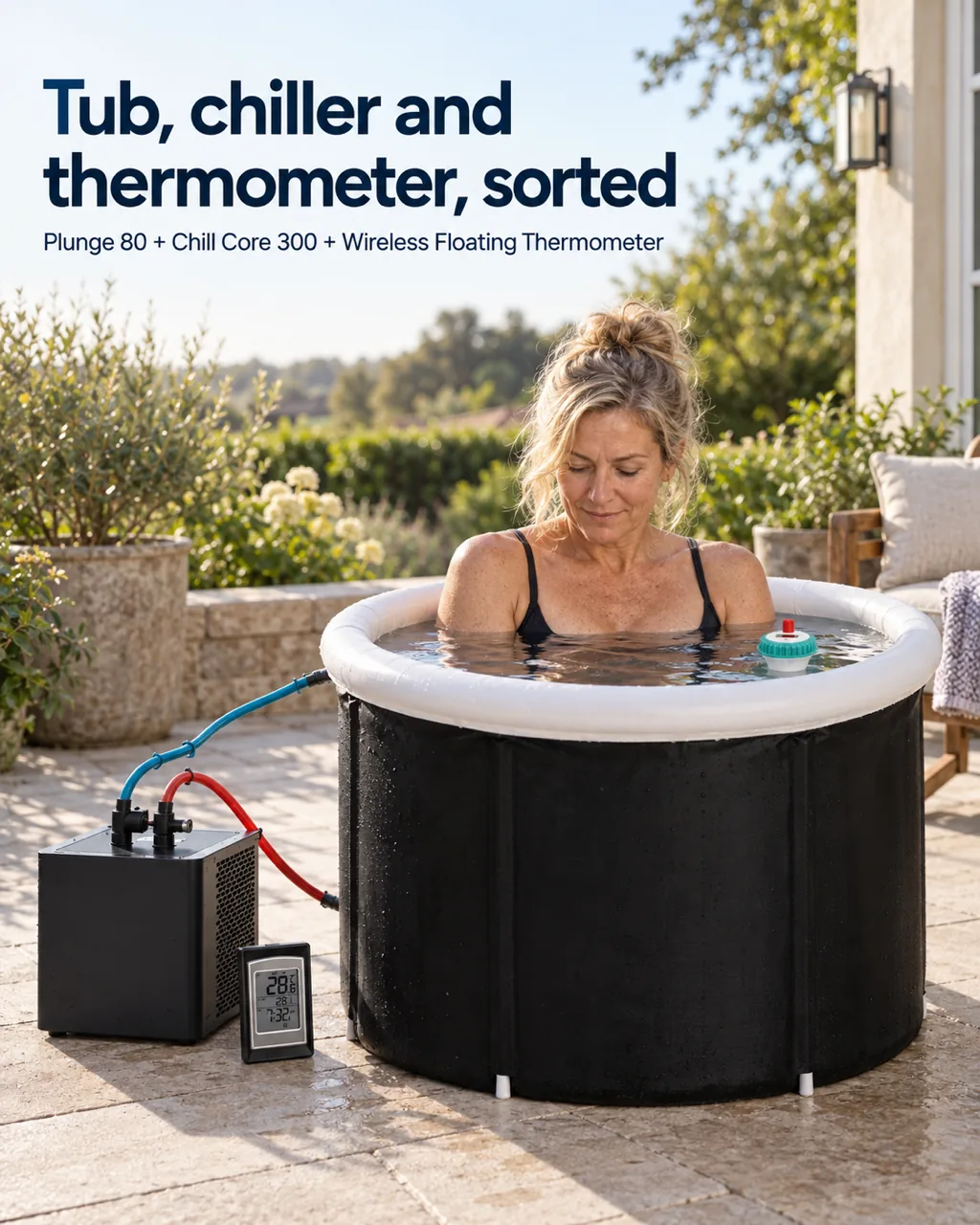
Then think about running cost. If you're buying ice, the insulation maths above is your running cost. If you eventually want a chiller, pairing a £599 Chill Core 300 with a tub that leaks cold is a poor use of the chiller. The Starter Bundle puts the Plunge 80 with the Chill Core 300 and a Wireless Floating Thermometer for £649, against £697 bought separately, and the chiller is rated by its supplier for up to 300 litres, so fill the tub below that.
Whatever the tub is made of, the water does the same thing to your body. The research Machado and colleagues pooled in 2016 found the best results for muscle soreness at water between 10 and 15°C for 10 to 15 minutes; you don't need ice-water extremes, and an inflatable that's warmed to 14°C is still in the band. Tipton and colleagues' 2017 review in Experimental Physiology frames cold water immersion as both a threat and a treatment depending on circumstance, and looks at it as a precursor to drowning, cardiac arrest and hypothermia. Whichever tub you buy: ease in, don't plunge alone, and get out if anything feels wrong. Our beginner's routine sets out a sensible progression.
The one safety point that does differ: an inflatable rim that gives way as you climb out is a slip risk on a wet patio. A foldable tub with legs gives you something that stays put.
Whichever way you lean, run through this before you pay. It's the list we go through with customers who email us.
We'd be daft to pretend there's no case for them. If you want to try cold plunging for a month before spending anything meaningful, an inflatable does that. If you take a tub to events or a training camp and it has to fit in a rucksack, an inflatable is the only thing that will. If you have almost no storage and the tub has to disappear into a cupboard between summers, the small pack size matters.
If any of those is you, buy the inflatable, use it, and when the valve starts hissing you'll know whether you're a plunger.
It's not for anyone who wants a lid and accessories in the box; that's the Plunge 320. It's not for someone who wants to lie flat; it's a sit-in, knees-up tub. It's not a compact travel tub either: 80 × 75cm is a real object, and you should check that footprint against your space before ordering. And if you specifically want triple-layer insulated walls, the supplier lists those on the 320, not the 80.
Buy the foldable Plunge 80 at £69 if you want a tub with proper walls at an inflatable price and you're happy to sort your own cover. Step up to the Plunge 320 at £109 if you want it insulated with the lid and everything else in one box. Buy an inflatable if you need it to fit in a rucksack or you're truly only testing the water for a few weeks.
Then fill it from the cold tap, add a bag of ice, and see how you feel at 12°C for ten minutes. The tub is the easy part. The setup guide covers the rest of the first day, and our Aldi ice bath review is worth a look if a supermarket inflatable is what tempted you here.
This article is for general information and does not constitute medical advice. Cold water immersion carries cardiovascular and hypothermia risk. Consult a doctor before starting, never plunge alone, and stop immediately if you feel unwell.
This article is for general information and does not constitute medical advice. Cold water immersion is not a medical treatment. Consult a professional if you have cardiovascular conditions.
An inflatable ice bath holds its shape with air: the walls are air chambers you pump up, like a tall paddling pool. A foldable ice bath holds its shape with fabric walls and rigid supports (poles or legs), and usually only the top ring is inflated. The foldable type is heavier, sturdier and often insulated; the inflatable type is lighter, cheaper and packs smaller.
It works, in that cold water is cold water. The problems are practical: air-filled walls flex when you lean on them, a puncture empties the tub, and there is usually no insulation, so the water warms faster and you use more ice. For occasional use it can be fine. For regular plunging most people move to a foldable tub within a season.
The foldable type, when its walls are insulated. Water takes 4,184 joules per kilogram to change by one degree, so a tub of it holds a lot of cold; insulated walls slow how fast the air steals it back. Air-walled inflatables have no dedicated insulating layer, so the water warms faster in summer.
Physically, if it has ports, yes. Sensibly, it is a hard sell: a chiller is a £599-plus purchase and pairing it with a tub that loses cold quickly makes the chiller work harder. Our Starter Bundle pairs the foldable Plunge 80 with the Chill Core 300 for £649 for that reason.
Ours starts at £69 for the Plunge 80, a round 80 × 75cm foldable tub on its own with no lid or accessories. The Plunge 320 at £109 adds triple-layer insulated walls, an all-weather lid, headrest ring, seat cushion, hand pump and drain hose.
Setting up a home ice bath: the tub, a thermometer and optional chiller, where it goes indoors or out, and what an ice bath at home costs, with real prices.
Where to start, how fast to progress, and how to fit cold plunging around training without undoing your gains. A week-by-week plan grounded in the evidence.
Aldi ice bath review for 2026: the £24.99 Bestway-style inflatable and the £149.99 Crane Premium, what Aldi states, and when a £69 tub makes more sense.
Do you need an ice bath filter? What filters exist for home tubs, how often to change the water, and the sanitiser levels UK guidance uses, explained plainly.