Loading…
Guide
What is a cold plunge? Meaning, and cold plunge vs ice bath
11 min read
A cold plunge is what it sounds like: you get into cold water, up to your chest or shoulders, and sit there for a few minutes on purpose. That's the activity. The same two words are also used for the thing you sit in, so "I bought a cold plunge" and "I did a cold plunge" are both normal sentences. If you've come here asking what a cold plunge is, that's the answer, and the rest of this page fills in the details: how cold, how long, how it differs from an ice bath, and what you need to try one.
We sell cold plunge tubs, including the Plunge 320 at £109. You don't need one to find out what a cold plunge feels like, and we'll say how to do it with a bath and a cold tap first.
What is a cold plunge, exactly?
Three things make it a cold plunge and not a quick splash.
The water is cold. In research the practice is called cold water immersion. Bleakley and colleagues' 2012 Cochrane review describes it as immersion in water of less than 15°C. Cain and colleagues' 2025 review of wellbeing trials used the same line, counting cold showers, ice baths and plunges at 15°C or below. Versey and colleagues' review for athletes is looser and calls anything at or below 20°C cold. The usual range people aim for is 10 to 15°C, or 50 to 59°F.
Most of your body is in it. A plunge means immersion, typically seated with the water somewhere between your waist and your neck. That's the difference from a cold shower, where the water runs over you and you can step out of the stream.
You stay in for a set time. Anything from 30 seconds to 15 minutes. Cain's review only included exposures of at least 30 seconds. The studies on muscle soreness that Machado and colleagues pooled in 2016 found the best results at 10 to 15 minutes.
So a working definition: a cold plunge is deliberate immersion of most of your body in water at about 15°C or colder, for somewhere between half a minute and a quarter of an hour.
Cold plunge meaning: the activity and the tub
The phrase does double duty and it helps to know which one someone means.
As a verb or an activity. "I cold plunge most mornings." This is the practice, wherever it happens: a tub, a lake, the sea, a bath at home.
As a noun for equipment. "We've got a cold plunge in the garden." Here it means a tub or small pool made for the job. In shops and adverts, "a cold plunge" often means a tub with a chiller attached, so the water stays at a set temperature without ice.
Plunge pool. An older term for a small, deep, cold pool beside a sauna or steam room in a spa. Same idea, built in.
You'll also see "cold water immersion" or CWI in studies, "cold water therapy" and "cold therapy" in marketing, and "ice bath" everywhere. Wikipedia's entry on the ice bath uses ice bath, cold-water immersion, cold plunge and cold therapy more or less interchangeably, which reflects how people actually talk.
Cold plunge vs ice bath
This is the question behind a lot of searches, and the honest answer is that there's no official difference.
If you want a rule of thumb for how the words tend to be used:
- An ice bath is a tub of water made cold with ice. The term comes from sport. Wikipedia defines it as a training regimen following intense exercise in which a substantial part of the body is immersed in ice or ice water for a limited time.
- A cold plunge is a tub of water kept cold by whatever means, often a chiller, and the term is used for general wellbeing as much as for sport.
That's usage, not science. No study we've read treats them as different things. Water at 12°C is water at 12°C whether a bag of ice or a refrigeration unit got it there.
One practical difference does follow from the names. Ice is cheap to start with and a chore to keep up. A chiller costs hundreds of pounds and then holds the temperature for you. If you try cold plunging with ice and find you're doing it four times a week, that's when people start looking at chillers. Our do you need a chiller page walks through that decision.
So when you see a product sold as an "ice bath" and a near-identical one sold as a "cold plunge", compare the size, the lid, the insulation and the price. The label tells you nothing.
How it differs from a cold shower, wild swimming and cryotherapy
Cold shower. Cold water, no immersion. It's the easiest way to start and costs nothing. It's also harder to control: the temperature is whatever the mains delivers, and only part of you is under the water at once. Our ice bath vs cold shower page compares the two properly.
Cold water swimming. Immersion, plus exercise, plus open water. Knechtle and colleagues' 2020 review notes it has a long tradition in northern countries, and that competitive ice swimming takes place in water colder than 5°C. The same review is clear about the danger for people who aren't used to it, from the initial cold shock or from hypothermia. A plunge in a tub is a more controlled version: you know the temperature, you can stand up, and you're a step from a towel.
Cryotherapy chambers. Different altogether. Wikipedia describes whole-body cryotherapy as exposure to extremely cold dry air, below -100°C, for two to four minutes in an enclosed chamber. No water is involved. People sometimes lump the two together as "cold therapy", but the research on one doesn't transfer to the other.
Where cold plunging comes from
None of this is new. A Roman bath had three main chambers, and the last was the frigidarium, the cold room, with a small pool of cold water where bathers finished after the hot rooms (Wikipedia, frigidarium).
The Finnish sauna tradition does the same thing. Cooling down in a lake, a pool or a shower is described as part of the sauna cycle and as important as the heating, and in winter that can mean ice swimming or rolling in the snow (Wikipedia, sauna). If you're curious about combining the two, that's covered on our sauna and cold plunge page.
Tipton and colleagues' 2017 review traces the history of cold water immersion and makes a point worth keeping in mind: cold water has long been treated both as a hazard and as a treatment, and which one it is depends on the circumstances.
What's different about the current wave is mainly the equipment. Cheap insulated tubs and plug-in chillers have made it something you can do in a back garden.
What a cold plunge feels like
The first ten seconds are a shock. Your breath catches and speeds up, your skin stings, and every instinct tells you to get out. The British Heart Foundation describes this as cold shock: a faster heart rate, higher blood pressure and shortness of breath on entering very cold water.
If you breathe out slowly and stay still, that eases. After a minute or so many people find the water bearable, and then oddly calm. Hands and feet ache first. When you get out you'll feel wide awake, and your skin will be pink.
That's the experience people get hooked on. It's also the reason for the safety rules further down.
Why people do it
We'll keep this short, because it has its own page.
The best-supported reason is muscle soreness after hard exercise. Machado's meta-analysis found cold water immersion slightly better than passive recovery, and the Cochrane review found some evidence of less soreness in the days after exercise, from small, low-quality trials.
Beyond that, the evidence is newer and thinner. Cain's 2025 review found lower stress 12 hours after a plunge and reported better sleep quality and quality of life, with no improvement in mood, across a small number of randomised trials.
Many people simply like how they feel afterwards. That's a perfectly good reason.
What a cold plunge won't do is treat an illness, and we don't claim it burns fat or protects you from colds. The full, graded picture is on our ice bath benefits page.
How cold and how long, in brief
Aim for 10 to 15°C. Start at the warm end. Stay one or two minutes at first and build up over weeks. Ten minutes is a solid session and 15 is the most we'd do at home.
Both numbers have their own guides, so we won't repeat them here: the ice bath temperature guide covers how cold and how to get there, and how long to stay in an ice bath covers timing. If you want a week-by-week plan, use the beginner cold plunge routine.
What you need to try one
Less than the adverts suggest.
To try it this week: a bath, the cold tap, and someone else in the house. Run it cold, get in slowly, stay a minute or two, get out. A kitchen thermometer will tell you the temperature. That's a cold plunge.
To do it regularly: a tub that can stay filled. A household bath is awkward for this because you have to fill and drain it each time and other people want to use it. A dedicated tub lives outside or in the garage with the water in it and a lid on top.
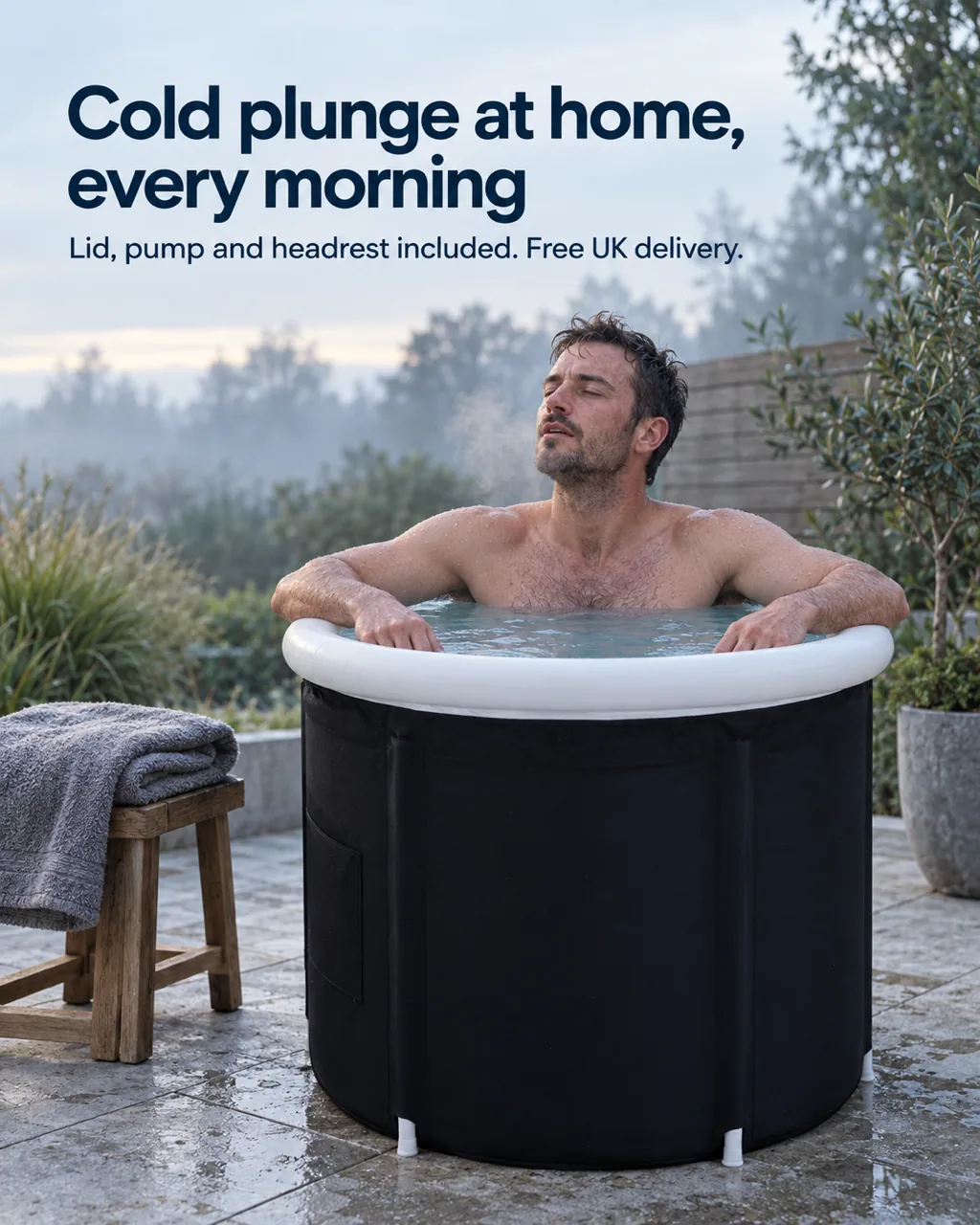
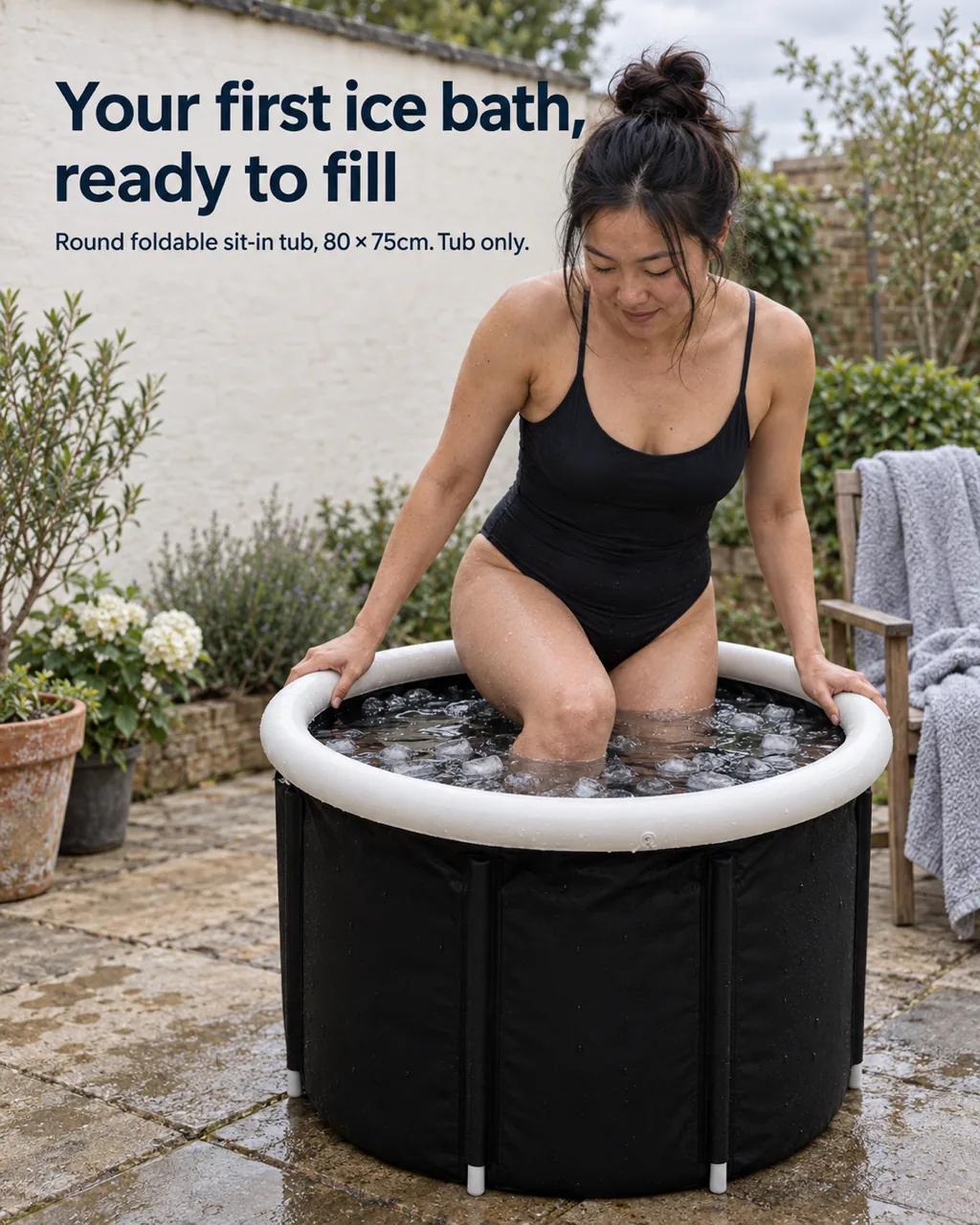
Ours are both round, foldable, sit-in tubs. The Plunge 80 is £69 and is the tub on its own, 80 × 75cm according to the supplier. The Plunge 320 is £109, 83cm across and 73cm tall, holds more than 380 litres according to the supplier, and comes with triple-layer insulated walls, an all-weather lid, six support legs, a seat cushion, a hand pump and a drain hose. Delivery on the 320 is free and tracked.
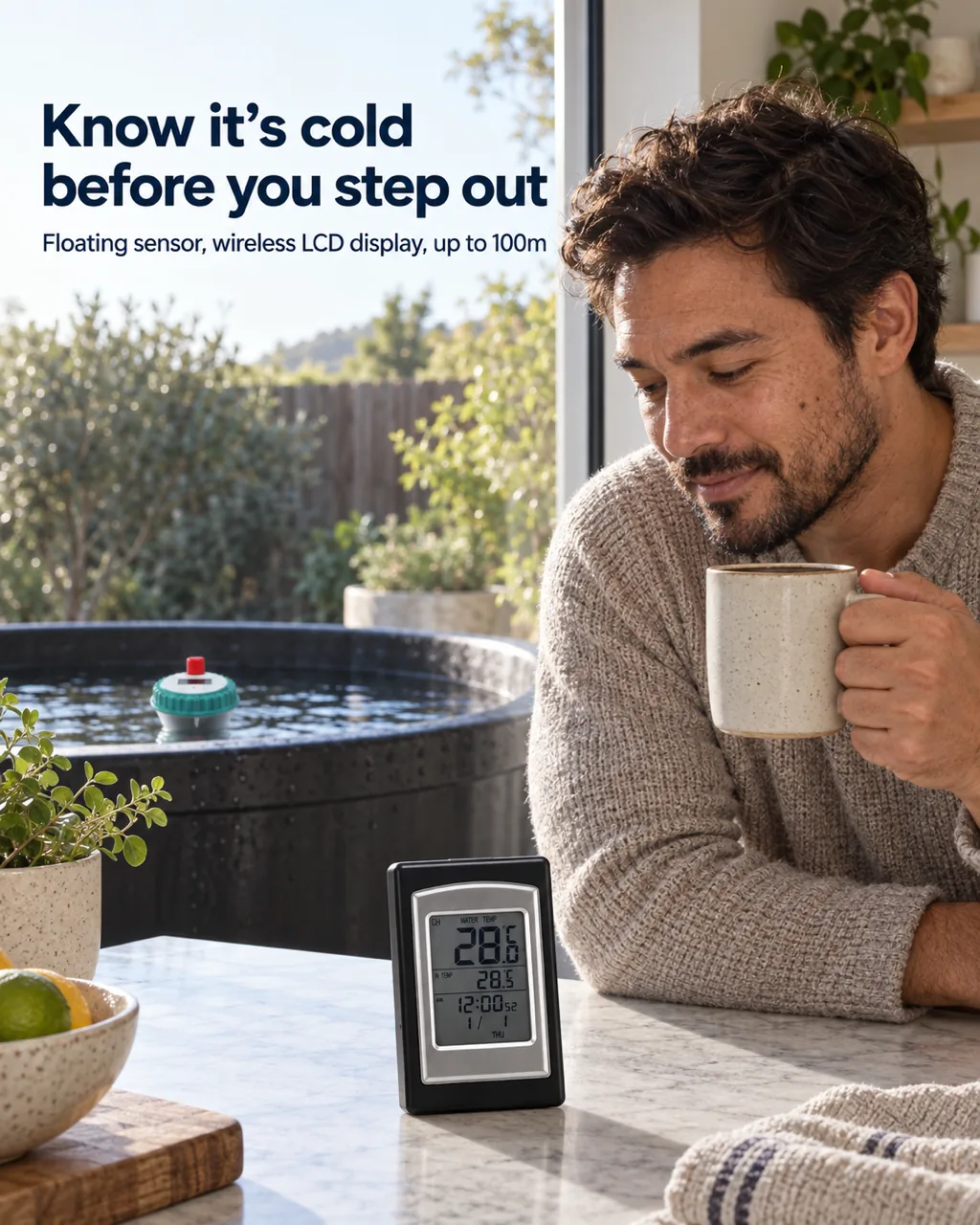
To know what you're getting into: a thermometer. Ours is the Wireless Floating Thermometer at £29, with a floating sensor and an indoor display.
Later, maybe: a chiller, if you plunge most days and are tired of ice. That's a purchase of several hundred pounds, and plenty of people never need one.
For choosing between tub types and sizes, our ice bath tubs guide is the place to go.
Safety basics
Cold water is a real stress on the body, and the first minute is when most of the risk sits.
- Get in slowly. Don't jump or dive.
- Breathe out steadily until the gasping settles.
- Don't plunge alone, especially when you're new.
- Keep early sessions short and the water no colder than about 15°C.
- Get out if you feel dizzy, confused, numb beyond your hands and feet, or have any chest discomfort.
- Dry off and dress warmly straight away.
The British Heart Foundation advises anyone with a heart condition to discuss the risks with a doctor or nurse before cold water swimming, and the same caution applies to a plunge at home.
Who a cold plunge is not for
If you have a heart condition, uncontrolled high blood pressure, Raynaud's, or you're pregnant, talk to your doctor before trying it.
It's not for anyone expecting a cure. It doesn't replace sleep, training or medical care.
Nor is it a great fit if you have nowhere to keep a tub and nowhere to drain one. Cold showers will do until you have the space.
And if you try it three times and hate it, you're allowed to stop. Plenty of fit, healthy people never go near cold water.
The short version
A cold plunge is sitting in cold water, usually 10 to 15°C, for a few minutes. "Cold plunge" and "ice bath" mean the same thing in practice, and the name on the box matters less than the size and what's included. You can try it in your own bath tonight.
If you decide to make it a habit, the Plunge 320 at £109 is the tub we'd start with: big enough to sit in, insulated, with a lid, and easy to fold away if you change your mind.
This article is for general information and does not constitute medical advice. Cold water immersion carries cardiovascular and hypothermia risk, particularly for people with heart conditions, uncontrolled high blood pressure, or a history of arrhythmia. Consult a doctor before starting, never plunge alone, and stop immediately if you feel unwell.
References
- 1.Wikipedia. Ice bath (definition, usual range of 10 to 15°C, related terms).
- 2.Bleakley C, McDonough S, Gardner E, Baxter GD, Hopkins JT, Davison GW. (2012). Cold-water immersion (cryotherapy) for preventing and treating muscle soreness after exercise. Cochrane Database of Systematic Reviews.
- 3.Cain T, Brinsley J, Bennett H, Nelson M, Maher C, Singh B. (2025). Effects of cold-water immersion on health and wellbeing: A systematic review and meta-analysis. PLOS ONE, 20(1), e0317615.
- 4.Versey NG, Halson SL, Dawson BT. (2013). Water immersion recovery for athletes: effect on exercise performance and practical recommendations. Sports Medicine, 43(11), 1101-1130.
- 5.Machado AF, Ferreira PH, Micheletti JK, et al. (2016). Can Water Temperature and Immersion Time Influence the Effect of Cold Water Immersion on Muscle Soreness? A Systematic Review and Meta-Analysis. Sports Medicine, 46(4), 503-514.
- 6.Knechtle B, Waśkiewicz Z, Sousa CV, Hill L, Nikolaidis PT. (2020). Cold Water Swimming: Benefits and Risks, A Narrative Review. International Journal of Environmental Research and Public Health, 17(23), 8984.
- 7.Tipton MJ, Collier N, Massey H, Corbett J, Harper M. (2017). Cold water immersion: kill or cure? Experimental Physiology, 102(11), 1335-1355.
- 8.Wikipedia. Frigidarium (the cold room and cold pool of a Roman bath).
- 9.Wikipedia. Sauna (cooling down in water as part of the sauna cycle).
- 10.Wikipedia. Cryotherapy (definition; whole-body chambers using air below -100°C).
- 11.British Heart Foundation. Cold water swimming: is it bad for your heart?
This article is for general information and does not constitute medical advice. Cold water immersion is not a medical treatment. Consult a professional if you have cardiovascular conditions.
Frequently asked questions
What is a cold plunge?
A cold plunge is getting into cold water up to your chest or shoulders and staying there for a short time, usually a few minutes. In research it is called cold water immersion and typically means water at 15°C or below. The word is also used for the tub itself.
What does cold plunge mean?
It has two meanings. As an activity, it means immersing your body in cold water on purpose. As an object, a cold plunge is the tub or pool you do it in, often one with a chiller that keeps the water cold without ice.
What is the difference between a cold plunge and an ice bath?
In practice, very little. Both mean sitting in cold water, and Wikipedia's entry treats the terms as interchangeable. If people draw a line, an ice bath is water cooled with ice and a cold plunge is a tub kept cold by a chiller. The water does the same thing either way.
How cold is a cold plunge?
Usually 10 to 15°C, which is 50 to 59°F. The Cochrane review on cold water immersion describes it as water below 15°C. Beginners can start at 15°C or slightly above.
How long do you stay in a cold plunge?
Beginners start with one or two minutes. The studies on muscle soreness found the best results at 11 to 15 minutes in water of 11 to 15°C, and we would not go past 15 minutes at home.
Do I need special equipment for a cold plunge?
No. A bath with cold tap water is enough to try it. A dedicated tub makes it easier to do regularly: ours start at £69 for the Plunge 80 and £109 for the Plunge 320 with a lid and insulated walls.
Related products
Related reading
Ice bath benefits: are ice baths good for you? The evidence
Ice bath benefits graded by evidence: what an ice bath does for soreness, stress, sleep and mood, where the research is thin, and who should not get in one.
Ice bath temperature: how cold should a cold plunge be?
The ice bath temperature most studies used is 10 to 15°C (50 to 59°F). How cold an ice bath needs to be, where beginners start, and how much ice it takes.
Ice bath tubs UK: sizes, materials and what's in the box
How to choose an ice bath tub in the UK: sit-in sizes in cm and litres, fabric vs inflatable vs steel vs wood, what is included, and what £69 to £109 buys.
How to build a cold plunge routine: a beginner's protocol
Where to start, how fast to progress, and how to fit cold plunging around training without undoing your gains. A week-by-week plan grounded in the evidence.