Loading…
Will a Plunge 320 fit my space? For most patios, gardens, garages and ground-floor bathrooms, yes: it needs a circle of level floor a little over 83cm across, a tap within hose reach and somewhere downhill for the water to go. The Plunge 320 is 83cm in diameter and 73cm tall according to the supplier, and holds more than 380 litres. The places it doesn't fit are less about the 83cm and more about weight and drainage: an upstairs room with a shared floor, or a balcony with nowhere for 380 litres to go. This page goes through how to check, space by space.
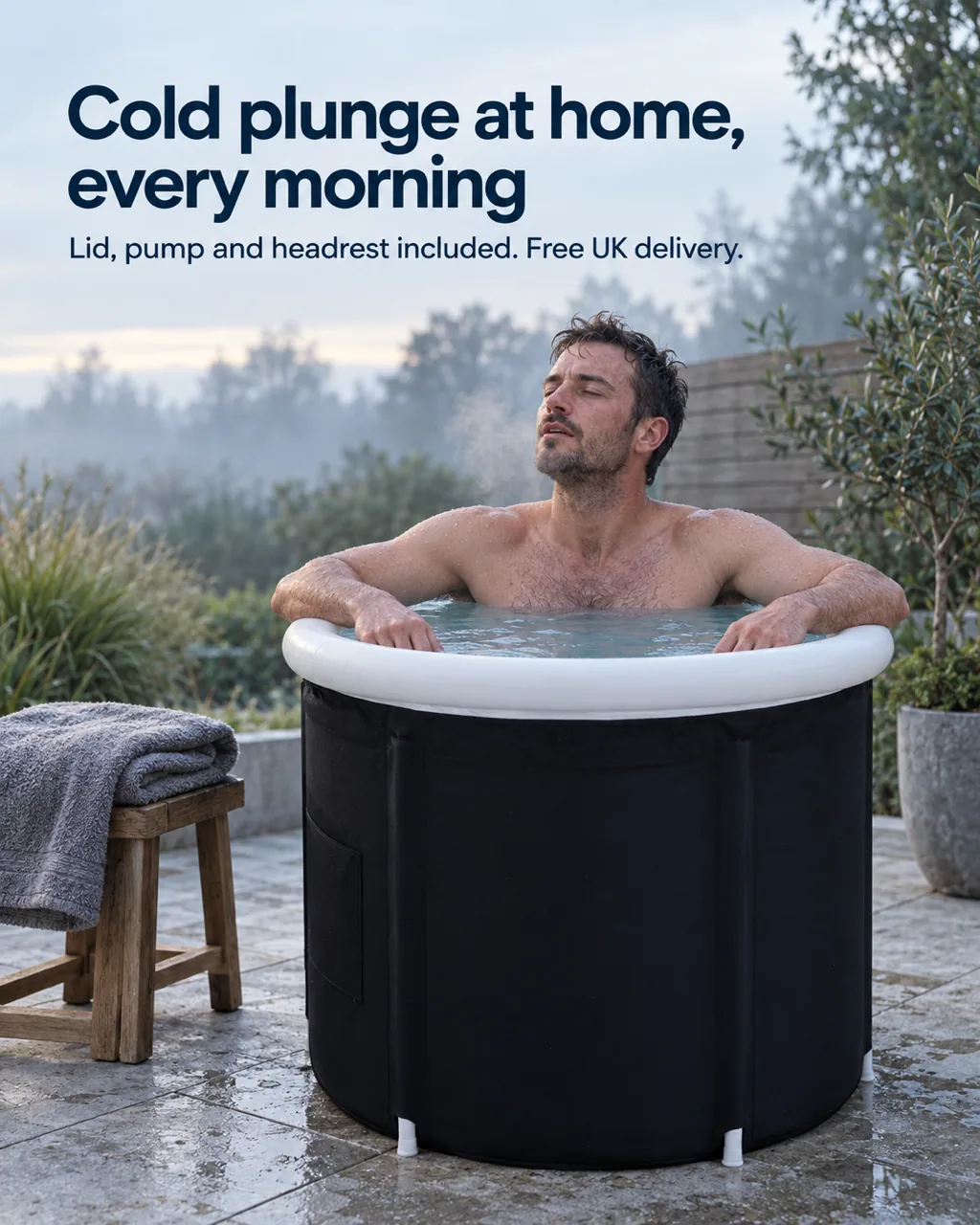
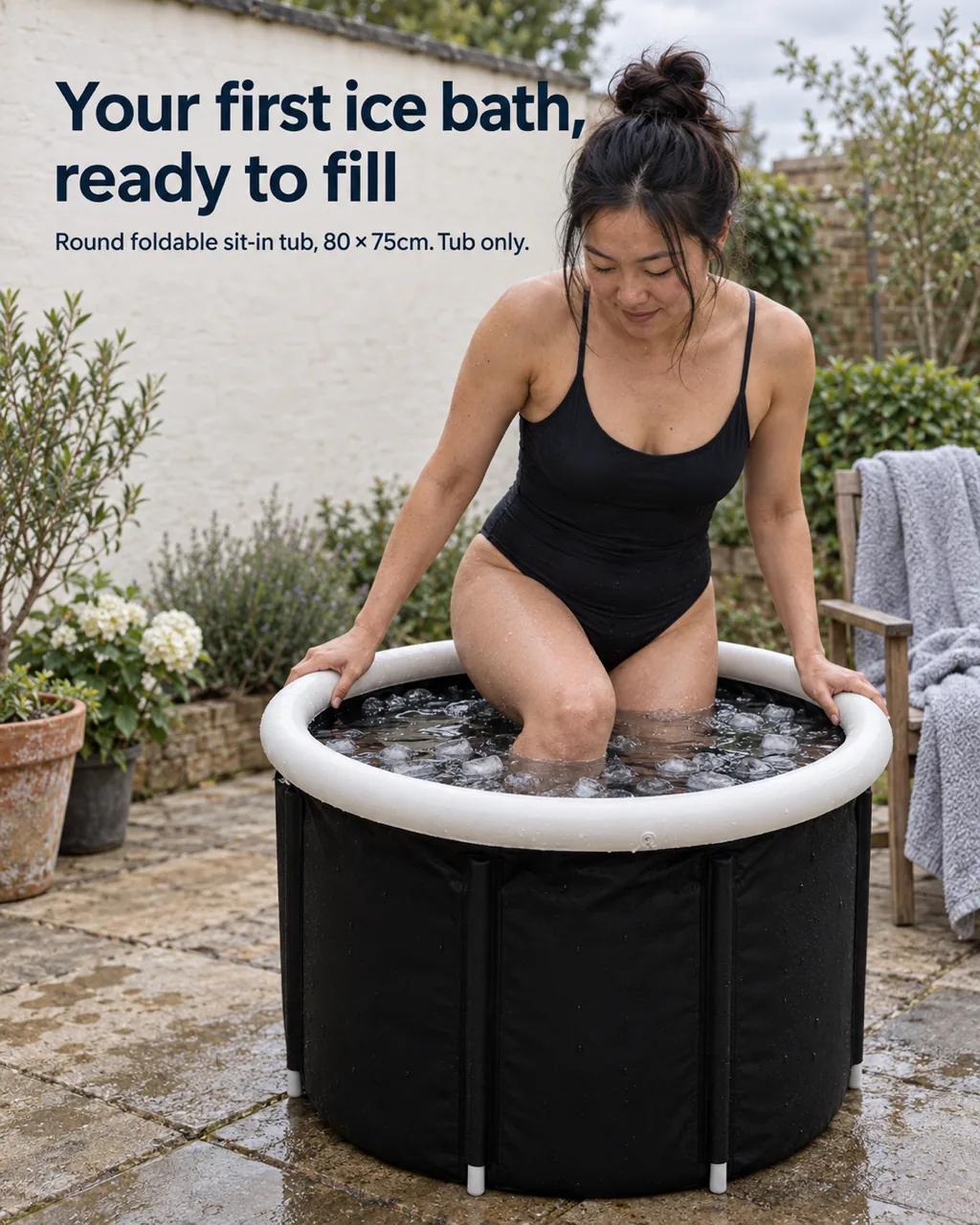
Everything here comes from the supplier's listing. The tub is 83cm across and 73cm tall when set up. It's round, so the footprint is a circle. Capacity is listed as more than 380 litres. It's a foldable fabric tub with triple-layer insulated walls, six support legs that clip on around the outside, an inflatable top ring, and it comes with an all-weather lid, a seat cushion, a hand pump, a drain hose and a seal ring.
The supplier doesn't publish a recommended clearance around the tub, and we're not going to invent one. What we'd say instead is: stand where the tub would go, imagine a circle 83cm across on the floor, and then act out stepping over the rim into it and climbing back out. If you'd hit a wall, a fence or a flowerpot doing that, you need more room. Then think about whether a chiller might sit beside it one day; the Chill Core 500, which is the one rated for this tub's volume, is 33.5 × 37 × 33.5cm and 28kg.
One number the listing does give and people skip: the water. One litre of water has a mass of almost exactly one kilogram (Wikipedia, litre), so 380 litres is roughly 380kg, plus the tub, plus you. Call it 400kg and up, concentrated on an 83cm circle. That's the number that decides balconies and upstairs rooms.
Run through these in order. If you get a no, stop there and fix it before ordering.
Seven yeses and the tub fits. Any no is a fixable problem or a reason to wait, and either is better than a return you pay postage on.
The tub fitting the space is half the question. You fitting the tub is the other half.
Sit on a kitchen chair, pull your knees up towards your chest the way you would in the water, and have someone measure from the back of your hips to the front of your kneecaps. That's the width you take up in a sit-in tub. If it's inside 83cm with a few centimetres spare, you're fine. Most adults are.
Height decides how deep the water is on you. The tub is 73cm tall. Sitting on the base with the water a hand's width from the rim, most people find the surface around their shoulders. Taller people sit lower and bend more; shorter people can use the included seat cushion to bring their shoulders up.
The easy case. You want a level bit of hard standing: paving, decking, concrete. Soft lawn lets the legs sink unevenly and the tub leans, and a leaning tub with 380 litres in it is a problem. If lawn is all you have, a couple of paving slabs or a firm board under the legs does the job.
Put it near the outside tap. Filling 380 litres from a garden hose takes a while, and a hose you have to drag across the garden every fill gets old. Think about shade too: a tub against a north-facing wall holds cold far better than one in the middle of a south-facing patio, because water is slow to change temperature (4,184 joules per kilogram per degree, Wikipedia, specific heat capacity) but the sun works on it all day.
Drainage: the included hose runs to a gully, a drain or a border that can take a lot of water. Run it downhill and open it. A lawn will not take 380 litres at once without pooling.
Decking: fine for most decking, but 400kg on an 83cm circle is a concentrated load, and old or poorly supported decking is worth a look underneath before you fill. If a joist is soft, you'll find out the wet way.
This is the one we get asked about most, and the honest answer is: sometimes.
Space-wise, an 83cm circle fits on many balconies with room to step in. The two real questions are load and drainage.
Load: roughly 400kg of water and person on an 83cm circle. Balconies are designed for people and furniture spread out, not for a small heavy footprint in one spot. We don't know your building, so the right person to ask is the freeholder, the managing agent or a structural engineer, not us and not a forum. If the answer is "probably fine," that's not a yes.
Drainage: where do 380 litres go? Many balconies have no drain at all, and the ones that do often feed a downpipe not designed for a tub's worth in a minute. Emptying over the edge is not an option. If you'd have to bail into buckets and carry them through the flat, you'll do it twice and then stop plunging.
Getting it there: empty and folded, the tub and its parts go up stairs and into a lift without fuss. That bit is fine.
If load and drainage both check out, a balcony tub is a lovely thing. If either doesn't, the Plunge 80 at £69 has the same weight-and-drain questions, so it's not the answer either; cold showers are, for now.
A ground-floor bathroom with a floor drain, or a bathroom where the tub can sit next to the bath and drain into it, is a good spot. Fill from the shower hose, drain with the included hose into the bath or toilet. Ventilate; a large body of cold water in a warm room makes condensation.
Check the door first. Assembled, the tub is 83cm across, and most internal doors are narrower than that. Carry it in folded, assemble it in the room.
Floor: a ground-floor solid floor, no problem. A suspended timber floor, or anything upstairs, is the balcony question again: 400kg on an 83cm circle. Bathrooms are built to carry a full bath, which is reassuring, but a bath spreads its load along its length and the tub doesn't. Ask if you're unsure.
Garage or utility room: usually the best indoor spot. Concrete floor, often a drain or a door to outside, no carpet to worry about, and the tub can live there all year with the lid on. Two things to check: that the garage door or a side door gives you a route for the drain hose to the outside, and that there's a socket within reach if you're thinking about a chiller. A garage also stays cooler than a conservatory in summer, which the water will thank you for.
The tub arrives as a box. Empty, it goes through any door, up stairs and into a lift. The six legs, the lid, the pump, the hose, the seal ring and the cushion pack alongside it. There's no awkward rigid shell to manoeuvre.
Where access does matter is if you add a chiller. The Chill Core 500 is 28kg gross and the Chill Core Pro is 36kg; those want two people on a staircase. If your tub spot is up a flight of steps, plan for that on chiller day.
The drain hose and seal ring are in the box. Attach the hose, run it downhill to wherever the water is going, and open it. Gravity does the rest. A drain, a gully, a soakaway, a large border or a hedge line all take it; a lawn takes some. Don't tip the tub; the seams and legs aren't designed for it.
If the only drain is uphill, a small submersible pump from a DIY shop, dropped in the tub with a hose to the drain, empties it quickly. That's an extra purchase and not something we sell.
You don't have to drain after every session. Most people leave the water in for days or weeks with the lid on, and drain when it needs changing. Our water care and maintenance guide covers how often and what to add.
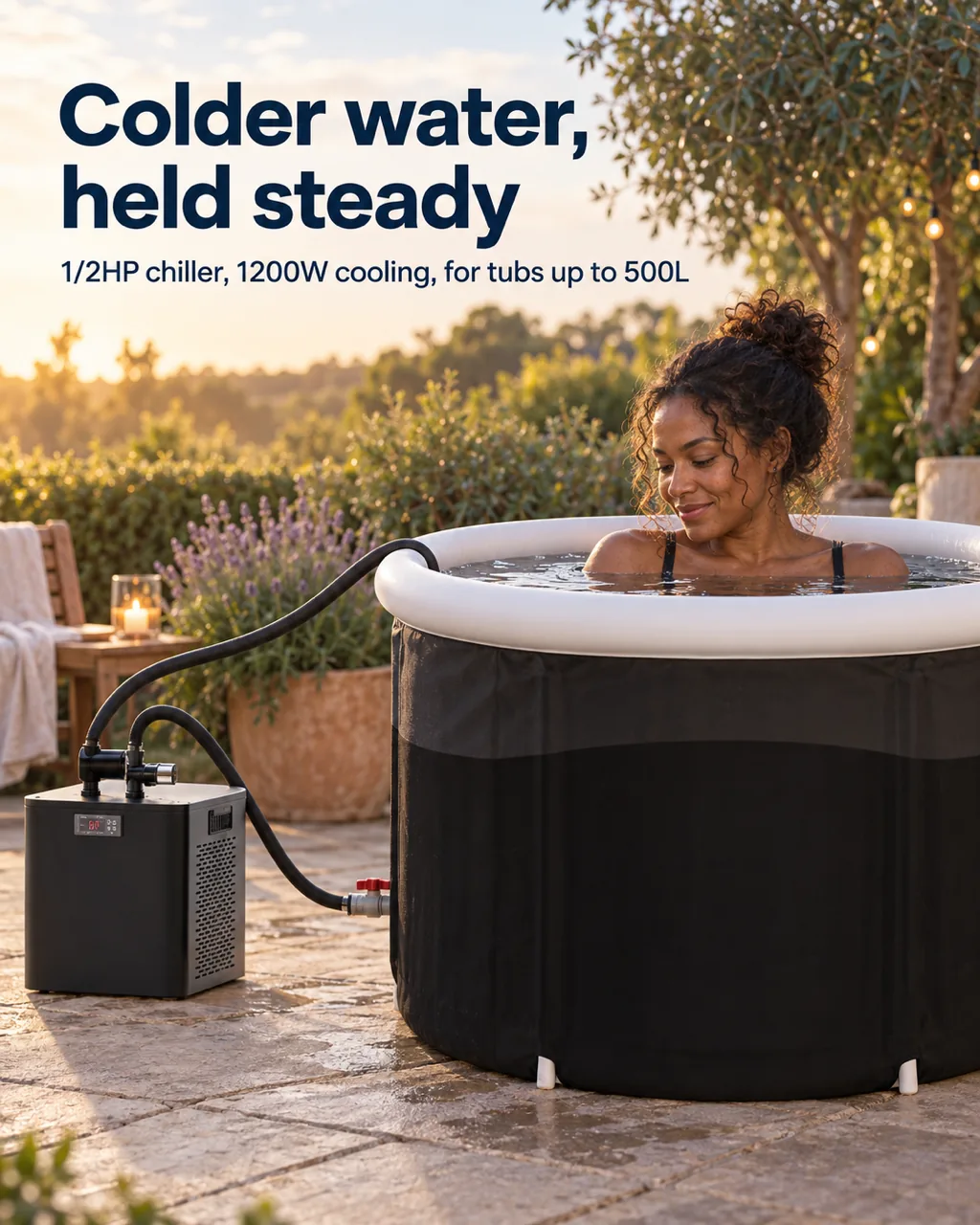
If you think you'll add a chiller, leave space for it now. The Chill Core 500, rated by its supplier for up to 500 litres and the right match for this tub's 380-plus litres, is 33.5 × 37 × 33.5cm. It wants a firm, level spot beside the tub with air around it and two hoses running to the tub. A chiller jammed against a fence in full sun works harder than it should. The Performance Bundle at £899 pairs the tub with that chiller and a thermometer if you want to plan the whole footprint at once.
A tub in a cramped spot is a tub you can't get out of quickly. Tipton and colleagues' 2017 review in Experimental Physiology looks at cold water immersion as a precursor to drowning, cardiac arrest and hypothermia as well as a treatment, and the practical side of that is: make sure you can stand up and step out without contorting, have something stable to hold, keep the floor around it from becoming an ice rink, don't plunge alone, and have a towel and warm clothes within reach. If the only place the tub fits is one where climbing out is awkward, it doesn't fit.
The Plunge 80 at £69 is 80 × 75cm, so 3cm narrower. It's not a meaningfully smaller footprint and it carries the same weight and drainage questions, so it's rarely the answer to a space problem. We'd rather tell you that than sell it to you as one.
If space is truly the constraint, cold showers cost nothing and our ice bath vs cold shower article is honest about what you give up. And if it's a temporary constraint, the tub folds: buy it when you have the spot.
Our supplier doesn't accept change-of-mind returns on the tub, so we don't offer returns beyond your legal rights: under UK distance-selling law you can tell us within 14 days of receiving it that you want to cancel, return it within 14 more, and the refund follows within 14 days of it arriving back (GOV.UK, accepting returns and giving refunds), with return postage at your cost. "It didn't fit" is a return you pay the postage on. So measure the circle, act out the climb, find the drain, and then order the Plunge 320 at £109 knowing it'll work.
This article is for general information and does not constitute medical advice. Cold water immersion carries cardiovascular and hypothermia risk. Consult a doctor before starting, never plunge alone, and stop immediately if you feel unwell.
The tub is 83cm in diameter and 73cm tall according to the supplier, so it needs a circle of level floor a little over 83cm across, plus room beside it for you to step in and out and for a chiller if you add one. The supplier doesn't publish a clearance figure, so measure your own space against the 83cm and be honest about the stepping-in room.
The supplier lists capacity at more than 380 litres. One litre of water weighs almost exactly one kilogram, so a full tub is close to 400kg of water before you get in. That's fine on a patio, garage floor or ground-floor bathroom. For a balcony or an upstairs room, ask whoever is responsible for the building.
Empty and folded, yes. It's a foldable fabric tub with six clip-on legs, so it arrives as a box and goes through a standard door, up stairs and into a lift. Assembled, it's 83cm across; most internal doors are narrower than that, so assemble it where it's going to live.
Physically it fits on many balconies. The two questions are whether the floor is rated for roughly 400kg concentrated in an 83cm circle, and where the water goes when you drain it. If you can't answer both, don't.
Through the drain hose included in the box, run downhill to a drain, gully, soakaway or a border that can take it. A lawn will not absorb 380 litres at once without pooling. If your only drain is uphill, a small submersible pump solves it.
It's a round sit-in tub 83cm across. Sit on a kitchen chair, hug your knees, and measure from the back of your hips to your kneecaps. If that fits inside 83cm with a few centimetres to spare, you fit. Taller people sit lower in the water; the tub is 73cm tall.
Setting up a home ice bath: the tub, a thermometer and optional chiller, where it goes indoors or out, and what an ice bath at home costs, with real prices.
How to do an ice bath at home, start to finish: filling, how much ice, checking the temperature, getting in, breathing, how long, warming up and clean-up.
Do you need an ice bath filter? What filters exist for home tubs, how often to change the water, and the sanitiser levels UK guidance uses, explained plainly.
Yes. Kaldera delivers ice baths, chillers and recovery gear to Ireland and 19 other euro-area countries, tracked and free over €115. How delivery and returns work.