Loading…
"Portable" is the most stretched word in the ice bath market. Every fabric tub gets called a portable ice bath, and some of them are, right up until you put water in them. This page is our honest explanation of what portable means for a tub like the Plunge 320 at £109: what you can pick up and carry, what you absolutely can't, and how to fill, drain and store one so that moving it is a ten-minute job rather than a wet afternoon.
Yes, in the way that matters: it folds down, the legs come off, and the whole kit goes in a car boot, through a standard door and up a flight of stairs when it's empty. It is not portable in the sense that people sometimes hope, where you slide a full tub across the patio to catch the shade. The supplier lists the Plunge 320's capacity as more than 380 litres, and one litre of water has a mass of almost exactly one kilogram (Wikipedia, litre). Nearly 400kg does not slide anywhere. Portable means empty.
Once you accept that, the tub is genuinely easy to live with. Here's how.
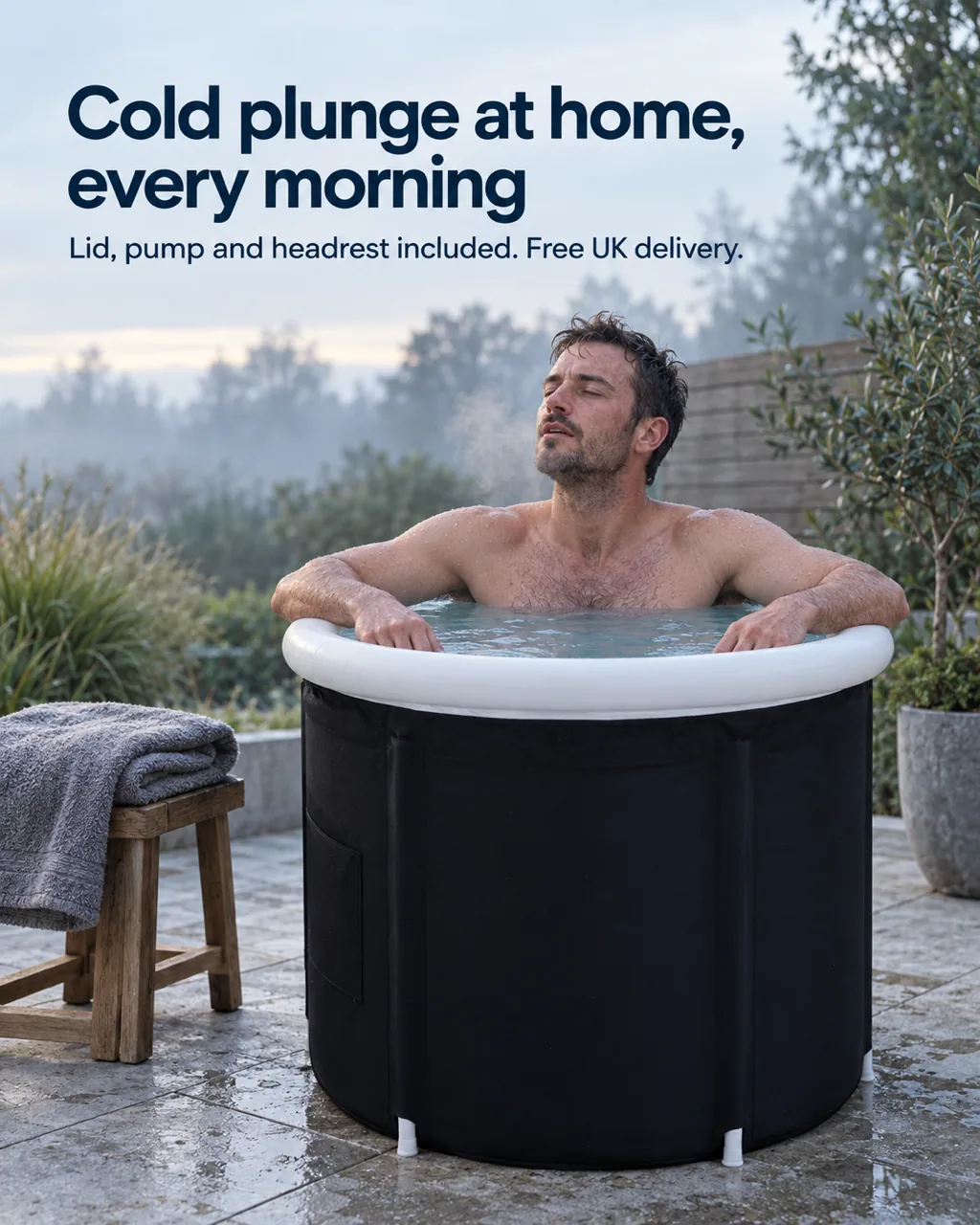
The Plunge 320 is a round, foldable cold plunge tub: 83cm across and 73cm tall when set up, according to the supplier. In the box you get the tub, an all-weather elasticated lid, six support legs, an inflatable seat cushion, a hand pump, a drain hose, a seal ring and the manual. Folded, the tub becomes a flat bundle of fabric; the legs are separate pieces; the lid, pump, hose and cushion are small. The supplier doesn't publish a packed weight or folded dimensions, so we won't invent them. Once it's folded, the job is a flat bundle plus a bag of parts, and nothing in it needs a van.
The inflatable ring at the top forms the rim and doubles as a headrest. It's the only part you pump, and you let the air out before folding. The walls are triple-layer insulated fabric, which is why the folded bundle has some bulk to it: that insulation is what keeps the water cold for longer once it's set up, and it doesn't compress to nothing.
The full first-day walkthrough is in our ice bath setup at home guide; this is the short version for a tub you're moving.
Pick the spot with three things in mind: a level surface, a tap or hose within reach, and a downhill route for the drain hose. Decking, a patio, a garage floor or a bathroom all work. Soft lawn lets the legs sink unevenly and the tub leans.
Read the manual, clip the six legs on, pump the ring firm, and then fill from the cold tap. Filling 380 litres from a garden hose takes a while; make a cup of tea. Water is heavy and hard to cool, at 4,184 joules per kilogram per degree (Wikipedia, specific heat capacity), so the first fill is where you add ice if you want it colder than the tap gives you. Put the lid on as soon as you're out.
Then check the temperature before you get in. The research Machado and colleagues pooled in 2016 found the best results for muscle soreness at water between 10 and 15°C for 10 to 15 minutes, and a UK tap for much of the year is not far off the top of that band on its own. A floating thermometer takes the guessing out: our Wireless Floating Thermometer at £29 sits in the tub and sends the reading to a display indoors.
Every portable ice bath guide skips this, and it's the whole job.
Use the included drain hose and seal ring rather than tipping the tub. Attach the hose, run it downhill to a drain, a gully, a soakaway or a border that can take the water, open it, and let gravity work. A lawn will absorb a lot but not 380 litres in one go without pooling, and a neighbour's fence line is not a drain. If you're in a flat or the only drain is uphill, a small submersible pump from a DIY shop turns a long wait into a short one; that's an extra purchase and not something in the box.
Once the tub is nearly empty, the last few litres won't run out through the hose. Sponge or bail them, then lift one edge to let the rest out. Now, and only now, the tub is light enough to move.
Water that's been in the tub a while wants treating or changing on a schedule. Our water care and maintenance guide covers what to add, how often to change it and how to keep it clear between fills.
Dry it first. Fabric folded wet and shoved in a garage goes musty, and that's the single most common way people ruin a good tub. Wipe the inside, leave it open in the air until the seams are dry, then take the legs off, let the ring down and fold along the natural lines rather than forcing new creases.
Store it flat or loosely rolled somewhere it won't be crushed under other things. Put the legs, pump, hose, seal ring and lid together in one bag so the next setup isn't a hunt. If it's going away for the winter, a quick look at the seams and the ring valve before you pack it saves finding a problem on the first warm day.
The lid earns its place here too: between sessions, with the tub full, it keeps leaves and insects out, and it slows the water warming in the sun. It's a debris cover, not a filter or a treatment system.
When the tub has to go from one place to another, this is the order that avoids a wet floor.
Done in that order, a move is about as much effort as mowing the lawn. Done in the wrong order, it's a mop and a bad mood.
People do take these to races, training camps, festivals and holiday lets. It works, with planning.
Water source first. You need a tap, a hose, or enough containers to ferry 380 litres, and the last of those is a lot of trips. Cold water only; you're not trying to warm it.
Drain second. Where does 380 litres go at the other end? A campsite with a chemical disposal point or a hard-standing area with a drain, fine. A field, less fine. Ask before you fill.
Ice third, if you want it colder than the tap. Bags of ice are heavy and melt in a hot car. A cool box helps.
And time. Setting up is quick. Filling, chilling, using, draining and drying is a half-day affair. If you're only at the venue for two hours, a cold shower and a changing poncho might be the better plan.
Portability is often really a question about space, so a few notes on each.
Ground-floor flat or house with a garden. Ideal. Tub on the patio, hose from the outside tap, drain hose to the gully. The 83cm footprint sits in a corner.
Balcony. Possible, with caution. The floor has to carry roughly 400kg of water plus you in a small area, and that's a question for the building, not for us. You also need somewhere to drain to that isn't the balcony below. Many balconies have no drain at all.
Upstairs flat, indoors. A bathroom with a floor drain or a bath you can drain into is workable. Fill from the shower hose, drain with the included hose into the bath or toilet. The floor loading question still applies.
Small garden or courtyard. Fine, as long as there's a level bit of hard standing. A tub on soft ground leans, and a leaning tub with 380 litres in it is a problem.
Our will a Plunge 320 fit my space page goes through the measurements room by room.
A tub in a new spot is a tub you don't know yet. A couple of things to keep in mind, drawn from Tipton and colleagues' 2017 review in Experimental Physiology, which looks at cold water immersion as a precursor to drowning, cardiac arrest and hypothermia as well as a treatment. Don't plunge alone, especially somewhere unfamiliar. Make sure you can get out easily: a tub set up next to a wall you can steady yourself on is better than one in the open. Keep the rim and the surrounding floor from becoming an ice rink. And have a towel and warm clothes within reach before you get in, not after.
If you want a tub that lives in one spot for years and looks like furniture, steel or wood is a better long-term buy and you don't need the fold-down capability at all. If you need something that fits in a rucksack, no sit-in tub of this size does; an inflatable is the smaller pack but comes with its own compromises, which we set out in our inflatable vs foldable guide. And if you're picturing moving the tub full to chase the shade, no tub does that, and you'd be better off picking the shady spot to begin with.
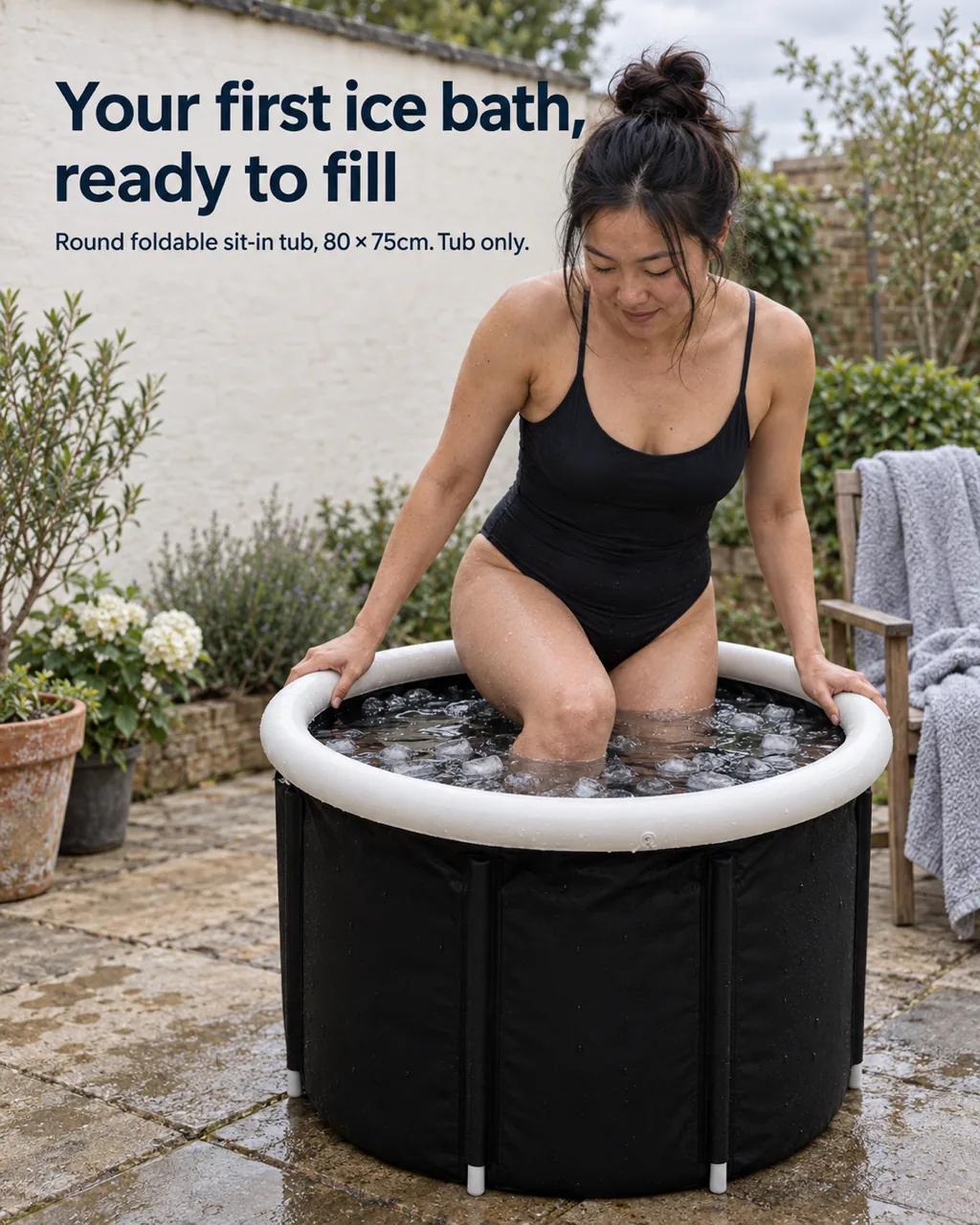
If you want the simplest possible object to carry, the Plunge 80 at £69 is just a tub, 80 × 75cm, with no legs, lid or accessories to pack. It's still a full sit-in tub though, not a compact travel one.
Delivery on the Plunge 320 is tracked and free, because it's over £100, with delivery listed at 10 to 16 days. You'll get a tracking number by email when it ships. If you're in Ireland or elsewhere in the euro area, our delivery to Ireland and the EU page has the details.
Our supplier doesn't accept change-of-mind returns on the tub, so beyond your legal 14-day right to cancel after delivery (return postage at your cost), we can't take it back because it didn't fit. Measure first. If it arrives faulty or damaged, we replace or refund it.
A portable ice bath is one you can fold, carry and set up somewhere else when it's empty. The Plunge 320 at £109 does that well: fold it, bag the legs and small parts, carry it through the door. The water is the thing that doesn't move, and the drain hose in the box is how you deal with that. Plan the fill, plan the drain, dry it before you fold it, and a tub that weighs 400kg on a Tuesday is in the boot of your car by Wednesday lunchtime.
This article is for general information and does not constitute medical advice. Cold water immersion carries cardiovascular and hypothermia risk. Consult a doctor before starting, never plunge alone, and stop immediately if you feel unwell.
This article is for general information and does not constitute medical advice. Cold water immersion is not a medical treatment. Consult a professional if you have cardiovascular conditions.
A tub you can fold or deflate, carry when it's empty, and set up somewhere else. In practice it means a fabric or inflatable tub rather than steel or wood. Portable does not mean you can move it full: the Plunge 320 holds over 380 litres according to the supplier, and a litre of water weighs almost exactly a kilogram, so a full tub stays where it is until you drain it.
83cm across and 73cm tall, supplier figures. It's round, so it needs a circle of floor a little over 83cm across plus room to step in and out.
Yes, empty. The Plunge 320 folds down and the six legs, pump, lid and hoses pack alongside it. You then need a tap or a water source at the other end, a level spot, and somewhere to drain 380 litres afterwards. That last one is the bit people forget.
No. Most people leave the water in for days or weeks and use the included lid to keep debris out. You empty it when the water needs changing, when you're moving it, or when you're putting it away for a season. Our water care guide covers how long water keeps.
The Plunge 320 comes with a drain hose and a seal ring. Run the hose downhill to a drain, gully or a border that can take the water. Do not tip the tub; the seams and legs are not designed for that.
It's the simpler object: tub only, 80 × 75cm, no legs, lid or accessories to pack. But it's still a sit-in tub, not a compact travel tub, and it holds a comparable amount of water. Neither one is a rucksack item.
Setting up a home ice bath: the tub, a thermometer and optional chiller, where it goes indoors or out, and what an ice bath at home costs, with real prices.
Do you need an ice bath filter? What filters exist for home tubs, how often to change the water, and the sanitiser levels UK guidance uses, explained plainly.
How to do an ice bath at home, start to finish: filling, how much ice, checking the temperature, getting in, breathing, how long, warming up and clean-up.
Yes. Kaldera delivers ice baths, chillers and recovery gear to Ireland and 19 other euro-area countries, tracked and free over €115. How delivery and returns work.