Essential storage keeps your basket and checkout working. With your permission, analytics helps us understand visits and purchases, and advertising cookies help measure ads. You can change your choice using Cookie settings in the footer.
What comes with the Kaldera Plunge 320? In the box you get the tub itself, an all-weather elasticated lid, six support legs, an inflatable seat cushion, a hand pump, a drain hose, a seal ring and the user manual. That's the supplier's list and it's the complete one: everything you need to put the tub up, fill it, sit in it, cover it and empty it. What's not in the box is a chiller, a thermometer or ice. This page goes through each part, what it's for, what to check when you unpack, and the two things we'd add. The tub is £109 with free tracked delivery.
The full contents, one by one
The tub
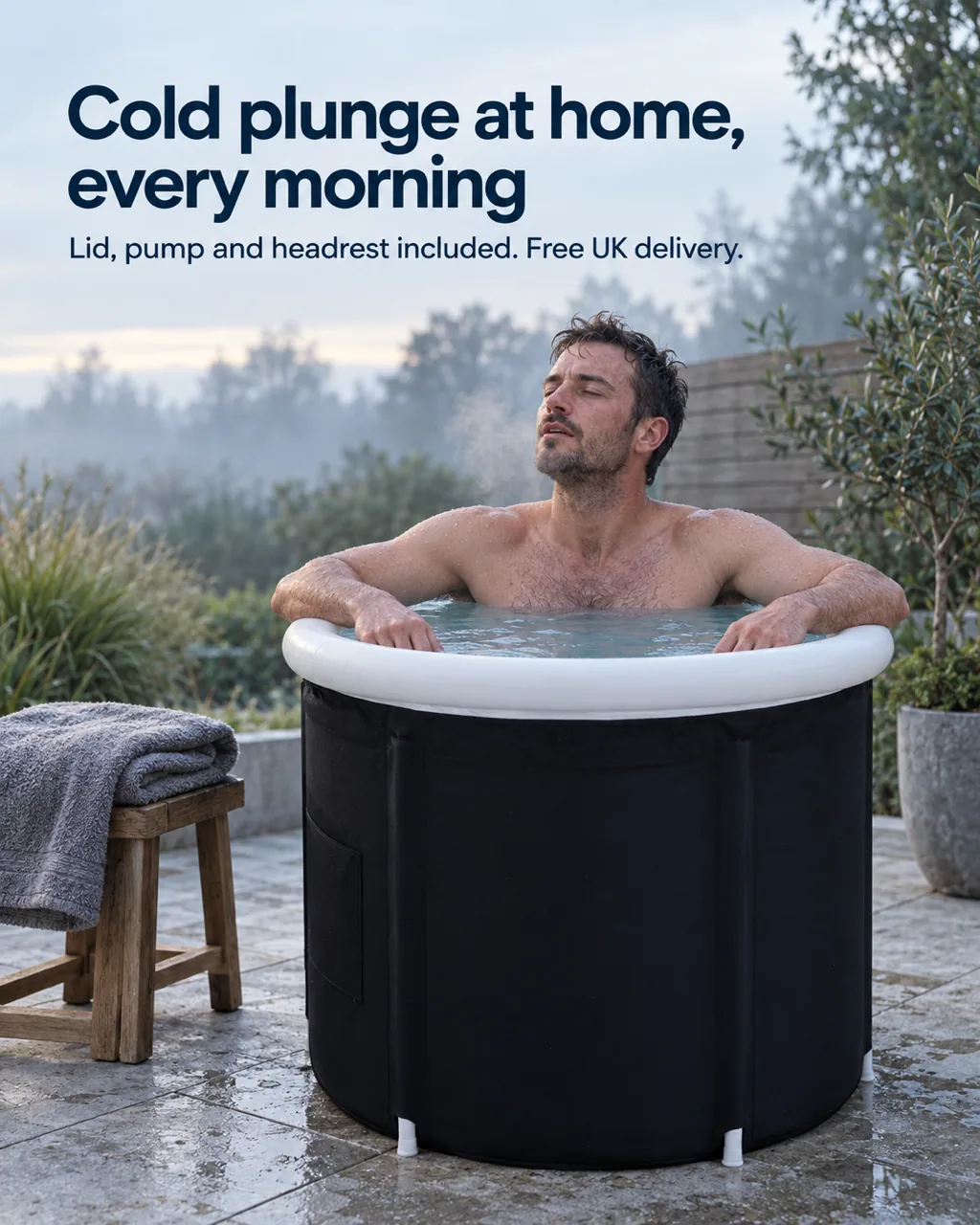
A round, foldable cold plunge tub, 83cm in diameter and 73cm tall according to the supplier, holding more than 380 litres. The walls are triple-layer insulated fabric, which the supplier says helps the water hold its temperature for longer. An inflatable ring runs around the top edge; it forms the rim and doubles as a headrest. The tub arrives folded and you'll assemble it where it's going to live, because assembled it's wider than most internal doors.
Plunge 320 is the name, not the capacity. The supplier's figure is 380-plus litres, and one litre of water weighs almost exactly one kilogram (Wikipedia, litre), so a full tub is close to 400kg. Put it on a level, hard surface that can carry that.
The all-weather elasticated lid
A cover that stretches over the top ring and stays put in wind and rain. Its job is to keep leaves, insects, rain and sunlight off the water between sessions. It matters more than it sounds: the sun on an open surface is the main way a tub warms up, and water is slow to cool back down again at 4,184 joules per kilogram per degree (Wikipedia, specific heat capacity), so every degree the lid saves is ice or chiller time saved.
To be clear about what it isn't: it is a debris cover, not a filter and not a water treatment system. Water left in the tub still needs looking after, and our covers that.
The tub, an all-weather elasticated lid, six support legs, an inflatable seat cushion, a hand pump, a drain hose, a seal ring and the user manual. The inflatable top ring that forms the rim and headrest is part of the tub itself.
Does the Plunge 320 come with a chiller?
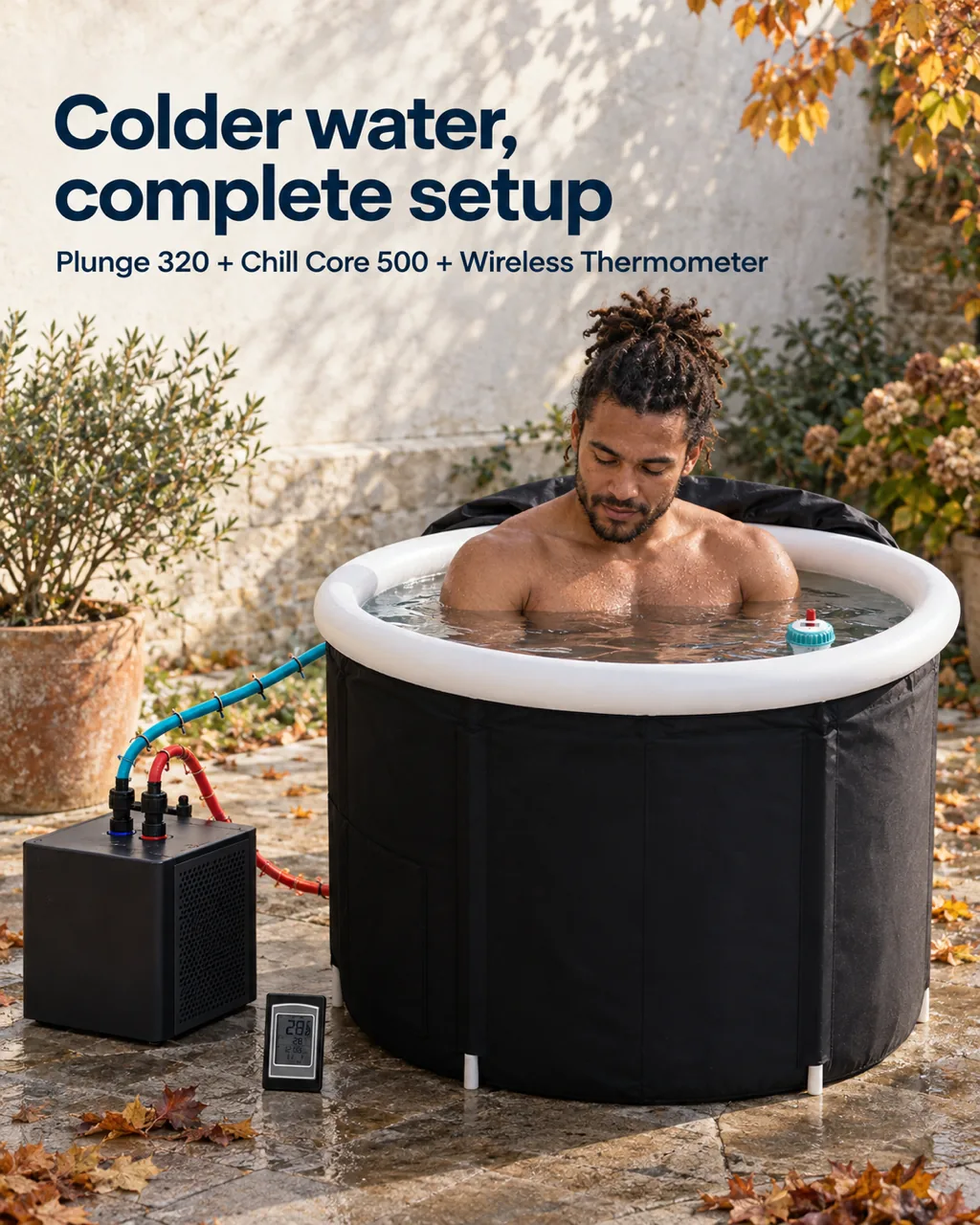
No. A chiller is a separate refrigeration unit, sold separately. The Chill Core 500 (£799) is the one rated by its supplier for this tub's 380-plus litres. The Performance Bundle at £899 pairs the tub, that chiller and a thermometer.
Does the Plunge 320 come with a thermometer?
No. Our Wireless Floating Thermometer is £29 on its own, or included in the Performance Bundle. We'd buy one; the research band is 10 to 15°C and you can't know you're in it without a reading.
Does the Plunge 320 come with a lid?
Yes. An all-weather elasticated lid is included. It's a debris cover that keeps leaves and sun off the water between sessions; it is not a filter or a water treatment system.
Do I need to buy anything else to use the Plunge 320?
Cold water and a level spot. Everything to assemble, fill, sit in, drain and cover the tub is in the box. Ice is optional, a thermometer is strongly advised, and a chiller is a separate decision.
Is Plunge 320 the capacity in litres?
No. Plunge 320 is the product name. The supplier lists the capacity as more than 380 litres. The tub is 83cm across and 73cm tall.
Rigid legs that clip on around the outside of the tub and hold its shape. The fabric walls don't stand up on their own; the legs do that job, and the inflatable ring finishes the rim. Six is the full set, so if you count five in the box, contact us before you fill it. Seat them properly according to the manual, on a level surface, or the tub leans.
The inflatable seat cushion
A separate inflatable pad you sit on inside the tub. Two uses. It raises a shorter person so their shoulders reach the water. And it makes the base more comfortable for anyone sitting still for ten minutes, which is roughly the duration the recovery trials used: Machado and colleagues' 2016 meta-analysis found the best results for muscle soreness at water between 10 and 15°C for 10 to 15 minutes. Ten minutes on a hard base is a long time. Inflate it with the hand pump.
The hand pump
For the top ring and the seat cushion. Pump the ring firm but not rock hard; it wants to hold its shape and cushion your neck, not be a tyre. You'll give it a few top-up pumps now and then over a season. It's a manual pump, so no power needed.
The drain hose and seal ring
The drain hose attaches to the tub's outlet and lets you empty 380 litres by gravity: run it downhill to a drain, gully, soakaway or border, open it, and wait. The seal ring makes the connection watertight. Together they are the reason you never tip the tub, which is hard on the seams and legs.
If your only drain is uphill, a small submersible pump from a DIY shop does the job; that's an extra purchase and not something in the box.
The user manual
Read it before assembly. It covers the order of putting the legs on, inflating the ring, filling, draining, cleaning and storage. Most of the questions we get about setup are answered in it. Keep it with the pump and the seal ring so the small parts stay together.
Unpacking checklist
When the box arrives, lay everything out and count before you fill anything.
Tub, folded, with the inflatable top ring attached
All-weather elasticated lid
Six support legs
Inflatable seat cushion
Hand pump
Drain hose
Seal ring
User manual
If anything is missing or damaged, photograph the box and the parts and contact us before assembly. Faulty or damaged deliveries are replaced or refunded; that's much simpler to sort before there's water in the tub.
While everything's laid out, test the two inflatables. Pump the seat cushion up and leave it for an hour; if it's still firm, good. Do the same with the top ring once the legs are on. And thread the seal ring and drain hose onto the outlet dry, so you know how the connection works before there are 380 litres pressing on it. Five minutes now saves a wet patio later.
What is not in the box
Being clear about this saves disappointment.
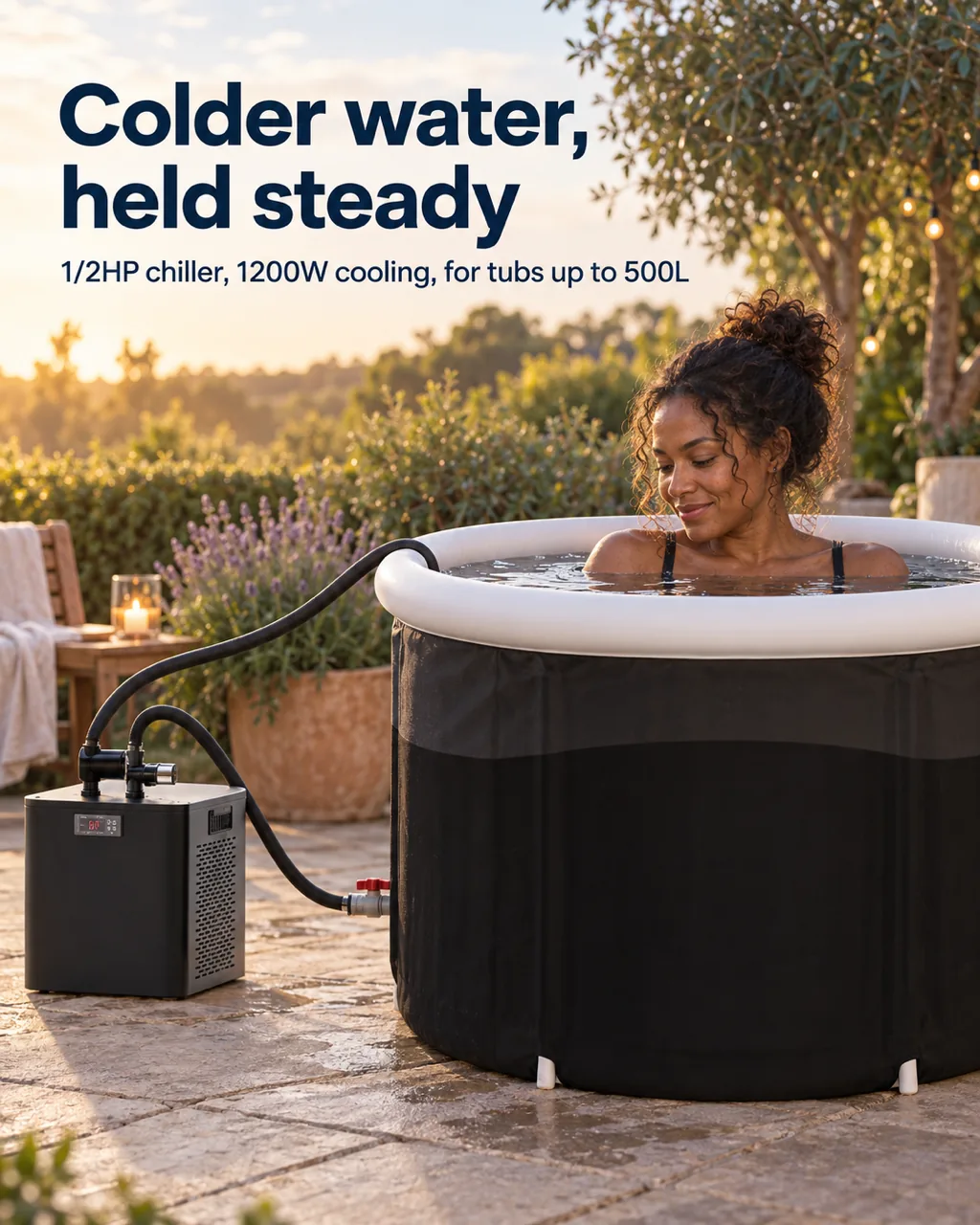
No chiller. A chiller is a separate refrigeration unit that pumps water out, cools it and returns it to hold a set temperature. The Plunge 320's 380-plus litres exceed the Chill Core 300's 300-litre rating, so the match is the Chill Core 500 at £799, rated by its supplier for up to 500 litres and cooling to about 4 to 9°C, or the Chill Core Pro at £999 for up to 900 litres. The Performance Bundle at £899 puts the tub, the Chill Core 500 and a thermometer together, £38 less than the £937 they cost separately. Ice works too, and is the cheapest way to start.
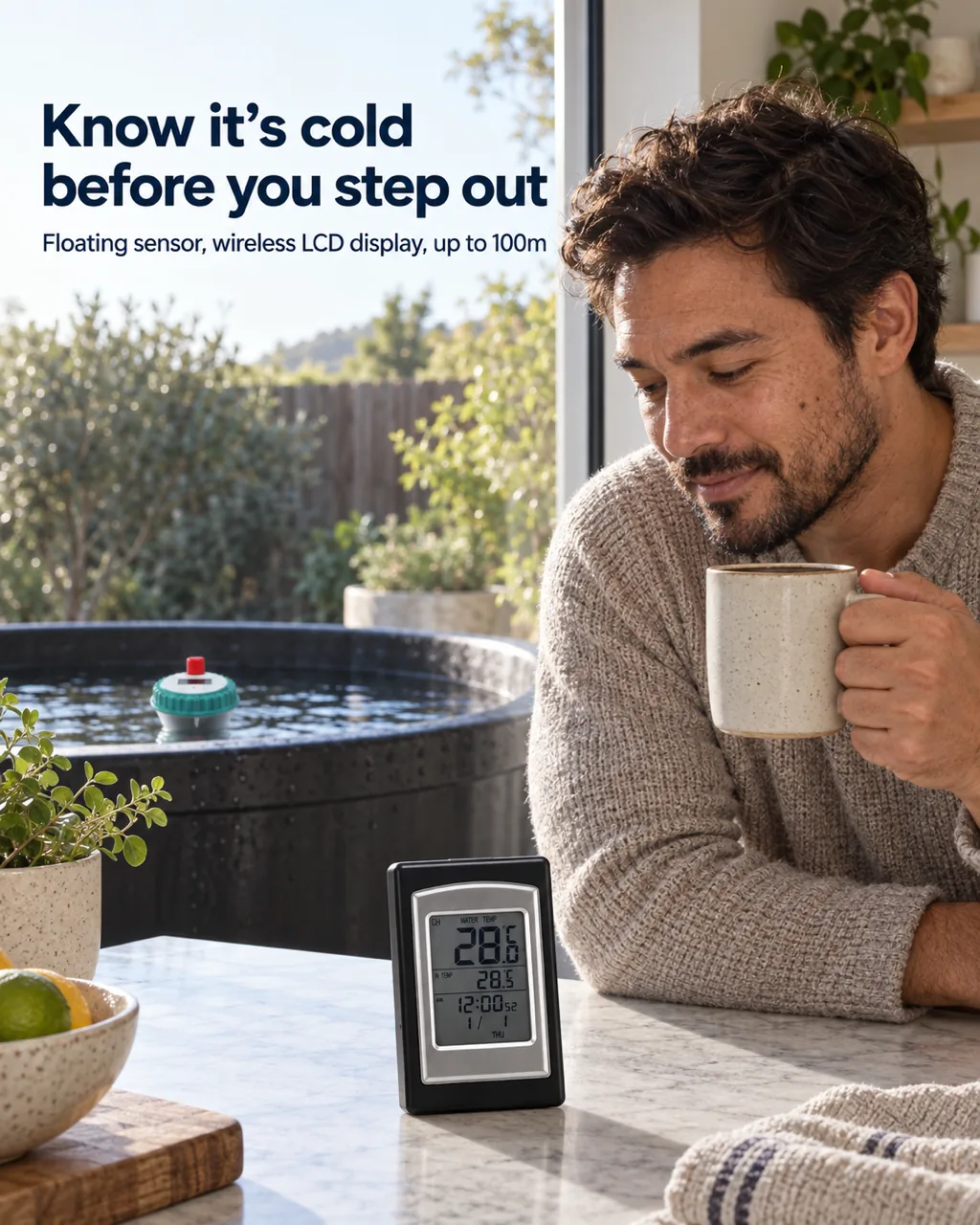
No thermometer. You'll be guessing the temperature without one. Our Wireless Floating Thermometer at £29 floats in the tub and sends the reading to a display indoors, up to 100m away. It's the first thing we'd add.
No ice. Obviously, but people ask. A UK cold tap for much of the year is near the top of the 10 to 15°C band on its own; ice takes it lower.
No water treatment. The lid keeps debris out; it doesn't keep water clean. What to add and how often to change the water is in the water care guide.
No batteries for anything, because nothing in the box needs them. The pump is manual.
No hoses for a chiller. If you add a chiller later, the chiller supplier doesn't list hoses or fittings in its box either, so ask us to confirm before ordering.
No cover for the chiller, no timer, no filter. None of these come with the tub because none of them are needed to use it. If you find yourself wanting one, that's a sign you've moved from trying cold water to living with it, and the chillers guide is the next thing to read.
Why the box is put together this way
It helps to understand what each part is solving, because that's also how you know which parts matter to you.
A fabric tub needs structure: the legs and the top ring. It needs a way in and out of comfort: the cushion and the headrest. It needs a way to get 380 litres out without wrecking it: the drain hose and seal ring. And it needs protecting between sessions: the lid. The manual ties it together. Nothing in the box is padding, and nothing you need for the basic job is missing.
What's deliberately left out is anything that depends on your situation. Whether you want a chiller depends on how often you plunge and where you live. Which thermometer you want depends on whether the tub is in view of the kitchen. What you add to the water depends on how long you leave it in. Those are your choices, and bundling them would force one answer on everyone.
Comparing the box with the Plunge 80
Our other tub, the Plunge 80 at £69, is the tub only: no lid, no legs, no cushion, no pump, no hose, no seal ring. That's how it stays £40 cheaper. If you'd buy a lid and a hose anyway, the Plunge 320's box is the better value; if you'd use a tarp and a garden hose you already own, the 80 is the cheaper buy. Our Plunge 80 vs Plunge 320 comparison puts the two side by side.
Pick a level, hard spot near a tap with a downhill route for the drain hose. Unfold the tub. Clip on all six legs as the manual shows. Pump the top ring firm. Fit the seal ring and drain hose, and make sure the outlet is closed. Fill from the cold tap. Inflate the seat cushion and drop it in. Put a thermometer in if you have one. Lid on while it settles.
Filling 380 litres from a garden hose takes a while. That's normal, and it's a good moment to read the manual's cleaning section so you know what the water needs later.
Check the temperature before you get in. Ease in for your first sessions rather than aiming for the full ten minutes, and never plunge alone; our beginner's routine sets out a sensible progression.
Looking after the parts
Lid: rinse it when you change the water, dry it before storing.
Ring and cushion: a few top-up pumps as needed. Let the air out before folding the tub for storage.
Legs: check they're seated each time you move the tub.
Drain hose and seal ring: rinse after use, store with the pump and manual so nothing goes missing.
Tub: dry it properly before folding for the season. Fabric folded wet goes musty, and that's the commonest way to spoil a good tub. Fold along the existing lines.
Delivery and returns
The Plunge 320 ships tracked, with delivery listed at 10 to 16 days and a tracking number by email when it goes. Delivery is free because the order is over £100.
Our supplier doesn't accept change-of-mind returns on this tub, so we don't offer returns beyond your legal rights. Under UK distance-selling law you can tell us within 14 days of receiving it that you want to cancel, return it within 14 more days, and the refund is due within 14 days of it arriving back (GOV.UK, accepting returns and giving refunds), with return postage at your cost. If it arrives faulty or damaged, or a part is missing, we replace or refund. So count the parts on day one.
Who this box is not for
If you want a lid-free, accessory-free tub at the lowest price, the Plunge 80 at £69 is the tub on its own, and we'd rather point you there than have you pay for parts you won't use. If you want to lie flat, this is a sit-in tub. If you want a chiller in the same box, that's the Performance Bundle, not the tub alone.
The short version
The Kaldera Plunge 320 at £109 comes with the tub, an all-weather elasticated lid, six support legs, an inflatable seat cushion, a hand pump, a drain hose, a seal ring and the manual. Everything to set it up, fill it, cover it and drain it. Add a thermometer at £29 so you know the water's in the 10 to 15°C band, add ice or a chiller if you want it colder than the tap, and you're done.
This article is for general information and does not constitute medical advice. Cold water immersion carries cardiovascular and hypothermia risk. Consult a doctor before starting, never plunge alone, and stop immediately if you feel unwell.